

Article with AI Analysis:
Date: June 10, 2026
Source: CoinDesk, analysis based on commentary by Scott Greytak
Introduction
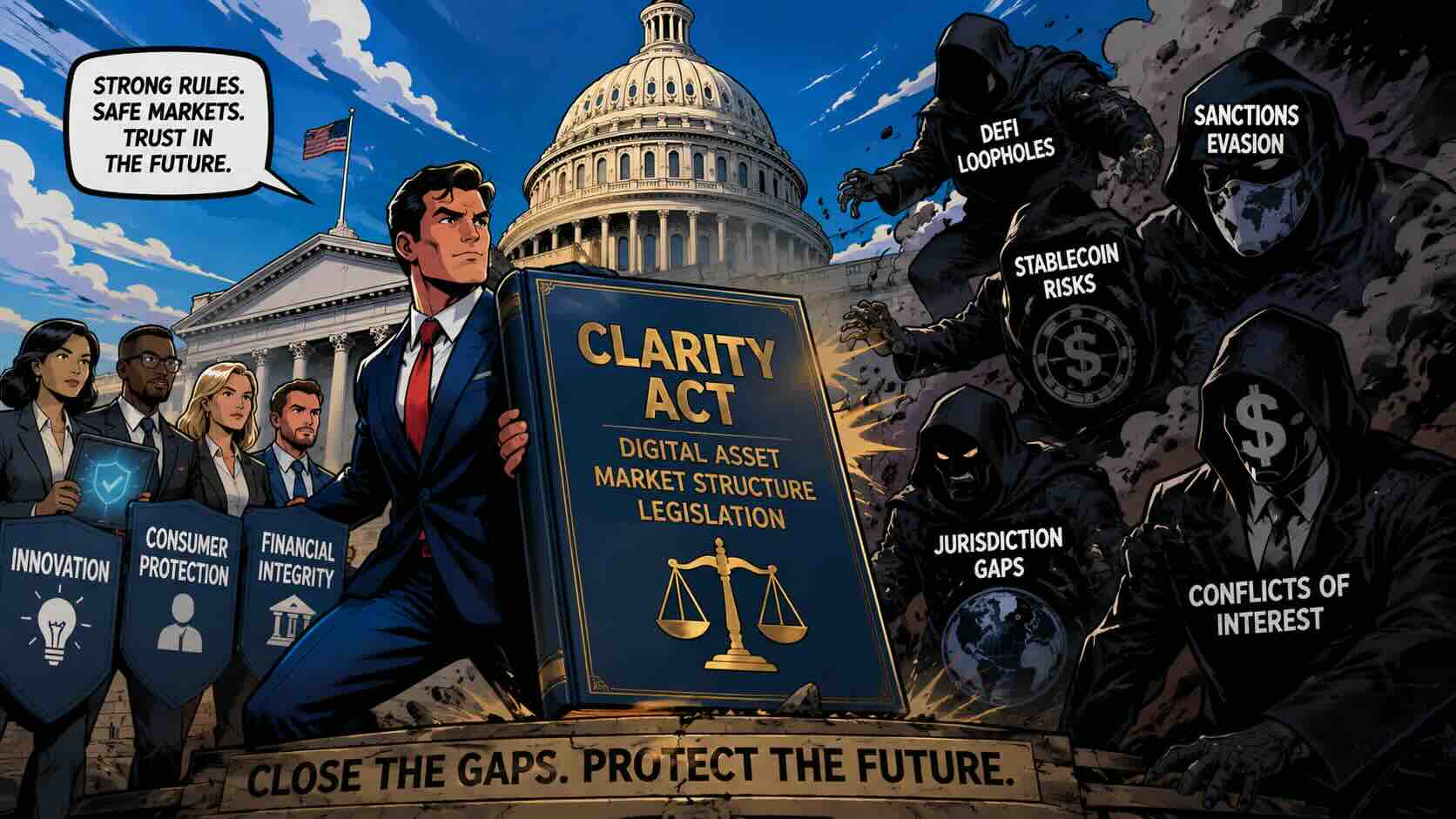
The United States is moving closer to implementing one of the most significant cryptocurrency regulatory frameworks in its history. The Digital Asset Market CLARITY Act aims to provide legal certainty for the digital asset industry, clarify regulatory responsibilities, and encourage innovation.
While many industry participants welcome the legislation, some experts argue that important gaps remain. According to anti-corruption advocate Scott Greytak, these gaps could create vulnerabilities related to money laundering, sanctions evasion, conflicts of interest, and financial transparency.
As lawmakers continue debating the bill, the discussion highlights a broader question facing the crypto industry: how can governments support innovation while protecting financial systems and public trust?
The DeFi Oversight Challenge
Decentralised Finance (DeFi) has become one of the most innovative sectors within cryptocurrency. By removing traditional intermediaries, DeFi allows users to borrow, lend, trade, and transfer assets directly through blockchain-based protocols.
However, critics argue that some platforms may be able to avoid regulatory scrutiny simply by describing themselves as decentralised.
Supporters of stronger oversight point to previous cases involving crypto mixers and laundering services allegedly used by sanctioned entities and cybercriminal organisations. They argue that if a platform performs financial functions, it should also meet certain compliance standards designed to prevent illicit activity.
The challenge for lawmakers is finding a balance that protects innovation without creating loopholes.
Stablecoins and Financial Transparency
Stablecoins have quickly become one of the most important parts of the cryptocurrency ecosystem.
Their ability to transfer digital dollars globally within seconds has attracted businesses, institutions, and consumers alike.
Critics of the current framework argue that bad actors could potentially exploit stablecoin networks through offshore services, decentralised platforms, or anonymous financial tools. They believe broader monitoring requirements may help reduce risks associated with sanctions evasion, fraud, and money laundering.
Supporters of stablecoins, meanwhile, warn that excessive regulation could slow innovation and reduce the competitiveness of the United States in the rapidly evolving digital economy.
The debate reflects the growing importance of stablecoins as both a financial technology and a geopolitical issue.
Jurisdiction and Cross-Border Enforcement
Cryptocurrency operates across borders, making regulation significantly more complex than traditional finance.
A company may be incorporated in one country, operate infrastructure in another, and serve customers worldwide.
This global nature creates challenges for enforcement. Regulators often struggle to determine which jurisdiction is responsible when financial misconduct occurs across multiple countries.
Some policy experts believe the CLARITY Act should include stronger provisions that prevent companies from avoiding compliance obligations simply by relocating corporate headquarters abroad while continuing to serve U.S. customers.
As crypto adoption grows globally, international cooperation is likely to become increasingly important.
Ethics, Conflicts of Interest and Public Trust
One of the most politically sensitive aspects of the debate involves potential conflicts of interest among public officials.
Critics argue that policymakers responsible for regulating digital assets should not have direct financial interests in businesses operating within the sector.
The issue has gained attention following reports involving investments connected to high-profile political figures and their families.
Regardless of political affiliation, transparency advocates argue that clear ethical boundaries are necessary to maintain public confidence in both financial regulation and democratic institutions.
Trust remains one of the most valuable assets in any financial system.
Why This Debate Matters Beyond Crypto
The discussion surrounding the CLARITY Act extends beyond cryptocurrency itself.
At its core, the debate focuses on questions that have shaped financial regulation for decades:
How much oversight is necessary?
How can innovation be encouraged without increasing systemic risk?
What safeguards are needed to prevent abuse?
How should governments balance privacy and security?
The answers will not only influence the future of digital assets but may also shape the next generation of global financial infrastructure.
As the legislation moves forward, both supporters and critics agree on one thing: the decisions made today could influence the cryptocurrency industry for many years to come.
AI-Powered Sentiment Analysis
Our AI analysis of this article revealed:
• Sentiment Score: 61/100
The overall sentiment is moderately cautious. The article highlights concerns and risks while maintaining a constructive discussion around regulatory improvements.
• Financial Sentiment: Neutral to Slightly Negative
The content focuses primarily on regulatory vulnerabilities and governance concerns rather than market growth or investment opportunities.
• Polarity Score: -0.18
The article leans slightly negative because it discusses risks, corruption concerns, sanctions evasion, and regulatory shortcomings. However, it avoids alarmist language.
• Subjectivity Score: 0.42
The article combines factual information with policy analysis and expert opinion, creating a balanced mix of objective reporting and interpretation.
What These Scores Suggest
The sentiment profile suggests that the article is primarily focused on risk management and regulatory integrity rather than market speculation.
From an investor perspective, the discussion may be viewed as positive over the long term because stronger regulations often contribute to greater institutional confidence, improved transparency, and broader adoption.
The article also reflects an increasingly important trend in the crypto sector: the transition from a largely unregulated environment toward frameworks designed to support both innovation and accountability.
For policymakers, businesses, and investors, the key takeaway is that regulatory clarity alone may not be enough. The effectiveness of any framework depends on how successfully potential loopholes and unintended consequences are addressed.
Read More
Read the full article on CoinDesk.
https://www.coindesk.com/opinion/2026/06/09/5-corruption-gaps-congress-must-close-in-the-clarity-act
You can also explore more cryptocurrency, technology, AI, and financial market analysis articles at:
Hikari Nova Blog
https://www.hikarinova.com/blog
For those interested in sentiment analysis, you can also try our recently updated AI-powered sentiment analysis platform, completely free to use:
Scored News
https://www.scorednews.com
Disclaimer
This article was generated using AI and reviewed for accuracy. The information presented is for educational purposes only and should not be construed as financial advice. Always consult with a professional before making investment decisions.