
Article with AI Analysis:
Date: April 26, 2026
Source: CoinDesk
Introduction
The idea sounds simple at first: protect Bitcoin from future threats.
But the reality is far more complicated.
A growing debate inside the crypto world is asking a difficult question should millions of dormant Bitcoin be frozen to protect them from quantum computing attacks? Or would that break the very foundation Bitcoin was built on?
At stake: trust, ownership, and potentially hundreds of billions of dollars.
The Bitcoin Freeze Debate: Security vs Principles
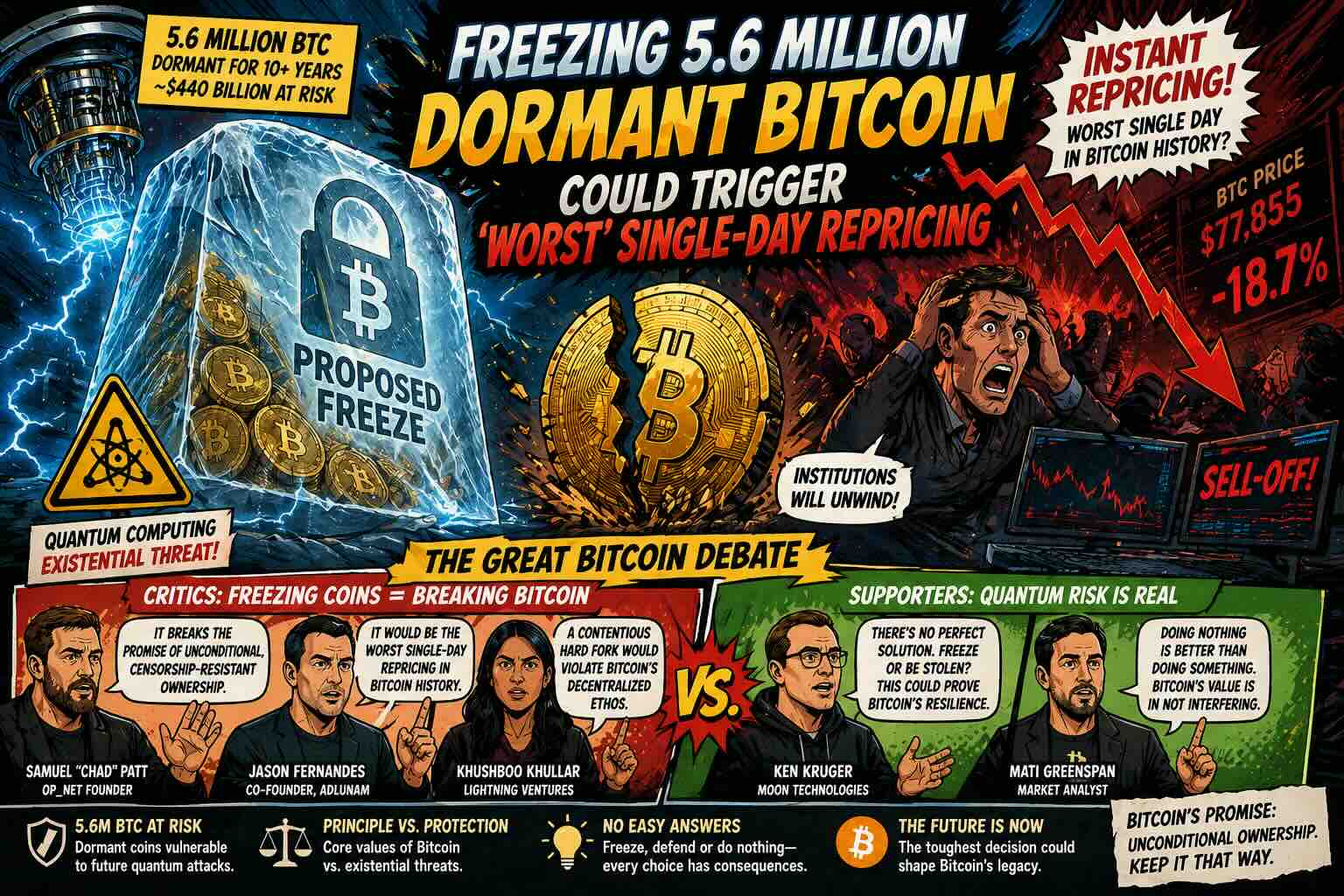
Around 5.6 million BTC worth roughly $440 billion has been inactive for over a decade. These coins are considered vulnerable if quantum computing becomes powerful enough to break older cryptographic protections.
Some developers, including Jameson Lopp, support the idea of freezing these funds through a proposal known as BIP-361. The goal is simple: prevent future theft before it happens.
But critics see it differently.
They argue that freezing coins even lost ones creates a dangerous precedent. If Bitcoin can freeze funds once, it challenges the idea of absolute ownership.
As one analyst put it:
“If ownership becomes conditional, the entire market will reprice instantly.”
Worst-Case Scenario: Instant Repricing
The fear isn’t just technical it’s psychological.
If the network decides to freeze coins, institutions may react quickly. Funds that invested in Bitcoin because of its censorship resistance could be forced to rethink their positions.
That could lead to:
Rapid sell-offs
Sharp price drops
A loss of long-term confidence
Some analysts warn this could trigger one of the worst single-day price movements in Bitcoin’s history not because of a hack, but because of a shift in trust.
Quantum Computing: A Real Threat or Distant Risk?
On the other side of the debate is a growing concern: quantum computing.
Experts warn that future quantum machines could break older Bitcoin wallets, especially those that haven’t been updated. If that happens, dormant coins could be stolen at scale.
Supporters of freezing argue:
Doing nothing could be more dangerous
Bitcoin must evolve to survive
Trade-offs are sometimes necessary
Others disagree, saying Bitcoin has always adapted without compromising its core principles pointing to upgrades like SegWit and Taproot.
The deeper question remains:
Is it better to act early and risk trust, or wait and risk security?
AI-Powered Sentiment Analysis
Our AI analysis of this article revealed:
sentiment_score: -0.22
Slightly negative, reflecting uncertainty and risk in the debateFinancial Sentiment: Bearish-neutral
Concerns about potential sell-offs balanced by long-term resiliencePolarity Score: -0.18
More caution than optimism in toneSubjectivity Score: 0.41
A mix of factual reporting and interpretive analysis
These scores suggest that the market narrative is cautious and divided. There is no clear consensus, only trade-offs.
From a deeper perspective, this is not just a technical debate it’s an emotional one. Bitcoin represents different things to different people:
For some, it’s freedom and ownership
For others, it’s a system that must evolve to survive
The sentiment reflects a market at a crossroads.
If Bitcoin chooses security, it risks losing part of its identity.
If it chooses purity, it risks future vulnerabilities.
This tension is what makes the situation so important and so difficult.
Read More
Read the full article on CoinDesk.
You can also explore more insights at:
https://www.hikarinova.com/blog
And try our newly updated sentiment analysis tool (free):
https://www.scorednews.com
Disclaimer
This article was generated using AI and reviewed for accuracy. The information presented is for educational purposes only and should not be construed as financial advice. Always consult with a professional before making investment decisions.