

Article with AI Analysis:
Date: May 7, 2026
Source: CoinDesk / Margaux Nijkerk
Introduction
For more than two decades, the internet has largely worked the same way.
Humans visit websites. Websites show ads. Businesses earn money from attention.
But what happens when humans are no longer the primary users of the internet?
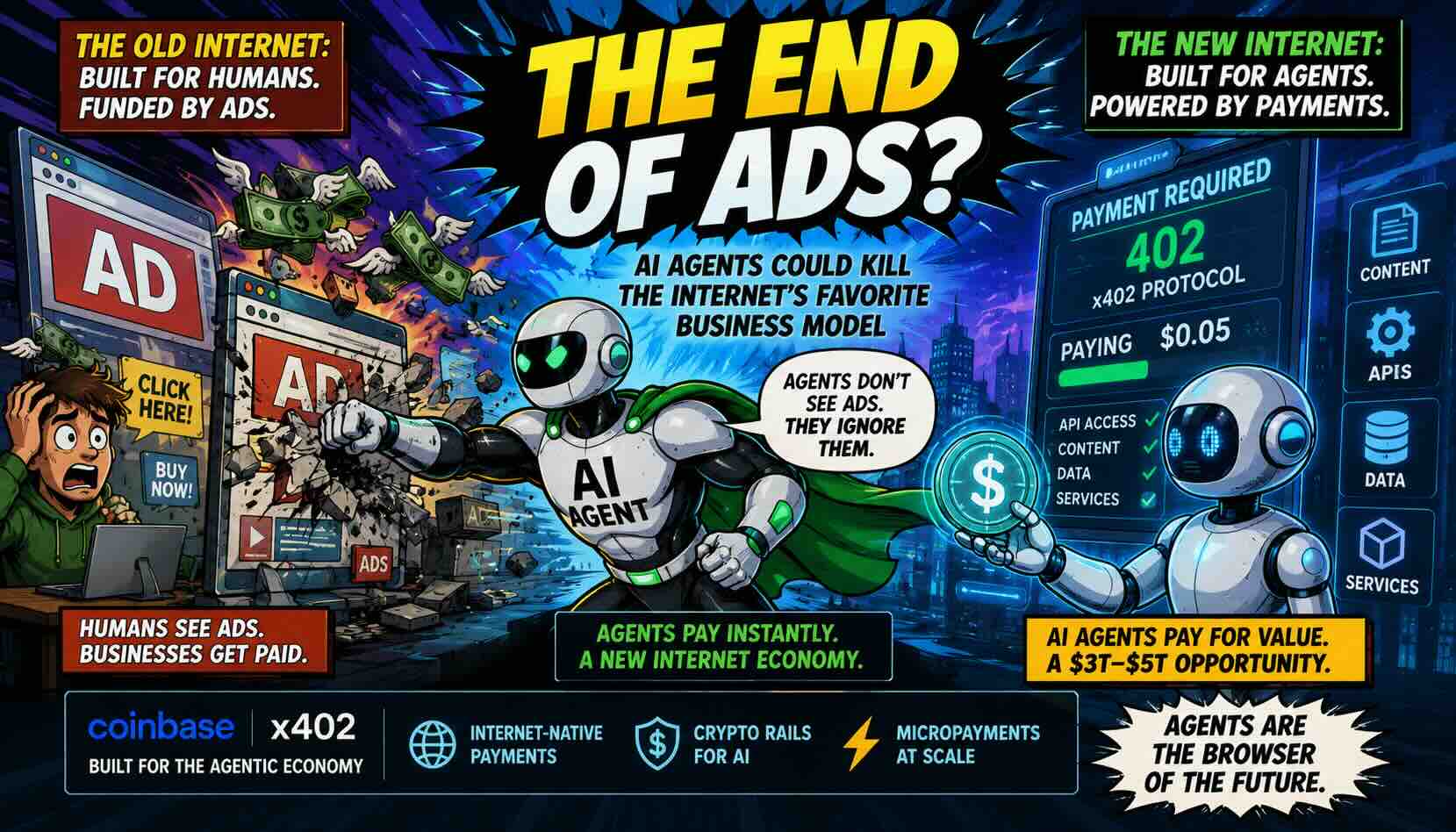
That question is starting to become very real as AI agents rapidly evolve. According to Erik Reppel, the rise of autonomous AI systems could fundamentally disrupt the internet’s advertising-based business model because AI agents simply ignore ads completely.
Instead, a new type of economy may emerge where AI systems automatically pay for content, APIs, and services using crypto-powered micropayments.
It sounds futuristic, but the foundations are already being built.
AI Agents Could Change How the Internet Makes Money

Speaking at the Consensus 2026 conference in Miami, Reppel explained that today’s internet was designed around human behaviour.
Websites were built assuming people would click, scroll, watch videos, and interact with advertisements. Entire industries now depend on that model.
But AI agents behave very differently.
They do not emotionally react to banners. They do not click sponsored recommendations. They do not care about visual marketing.
They simply complete tasks.
According to Reppel, that creates a major problem for the current internet economy because advertising revenue depends almost entirely on human attention.
“Agents don’t see those ads. They just ignore those ads completely,” he explained during the discussion.
That single shift could eventually force businesses to rethink how websites, apps, and digital services are monetized.
From Ads to Micropayments

Instead of advertising, Reppel believes the future internet may rely more heavily on direct digital payments.
His proposed solution is called x402 an open payment protocol built around the rarely used HTTP 402 “Payment Required” status code.
The idea is relatively simple.
If a human visits a website, they might still see ads.
But if an AI agent accesses a service, API, or digital platform, the system could automatically charge a small fee using stablecoins or crypto rails.
In practical terms, this could create a machine-to-machine economy where AI systems pay tiny amounts instantly for information, data access, computing power, or digital content.
That model becomes especially interesting as AI agents begin performing more online tasks independently.
Instead of browsing the internet manually, future users may increasingly rely on AI assistants that gather information, compare products, book services, manage workflows, and even negotiate transactions automatically.
If that happens, digital payments may become more important than digital advertising.
Crypto Wants to Become the Infrastructure Behind AI Commerce

The discussion around AI agents is also becoming a major opportunity for the crypto industry.
Stablecoins, blockchain payments, and crypto settlement systems are increasingly being positioned as infrastructure for what some are calling the “agentic economy.”
Reppel estimates that this emerging market for internet-native payments could eventually grow into a $3 trillion to $5 trillion sector within the next four years.
That number reflects a broader belief forming inside both AI and crypto circles: autonomous systems may need native digital payment tools that traditional banking infrastructure was never designed to handle efficiently.
This is one reason companies like Coinbase are investing heavily in AI-related payment infrastructure.
The long-term vision is not only humans using the internet but software interacting directly with software in real time.
And if that future arrives, the economics of the web could change dramatically.
Why This Matters Beyond Crypto
What makes this discussion particularly important is that it extends far beyond cryptocurrency itself.
Advertising currently funds much of the modern internet, including media platforms, search engines, blogs, social media, and free online services.
If AI agents begin replacing large amounts of human browsing activity, traditional advertising models may become significantly less effective over time.
That could push companies toward subscriptions, pay-per-use systems, micropayments, or AI-specific pricing models.
It could also reshape SEO, content creation, and online publishing.
For years, websites have been optimized mainly for human clicks and search rankings. But in an AI-driven internet, content may increasingly need to be optimized for AI agents retrieving information automatically.
That transition is already beginning.
And while it may take years before the full impact becomes visible, the conversation itself shows how quickly both AI and crypto are starting to influence the future structure of the internet.
AI-Powered Sentiment Analysis
Our AI analysis of this article revealed:
sentiment_score: 8.1/10
The article reflects strong optimism around technological innovation and the future growth potential of AI-driven internet infrastructure.Financial Sentiment: Bullish
The discussion positions AI payments, stablecoins, and crypto infrastructure as major long-term growth opportunities.Polarity Score: 0.47
The overall tone is clearly positive while still acknowledging uncertainty around how quickly the transition may happen.Subjectivity Score: 0.39
The article combines factual reporting with forward-looking industry opinions and future predictions.
These scores suggest that
The market narrative around AI and crypto is shifting from speculation toward infrastructure.
What makes this development important is not only the technology itself, but the economic implications behind it. If AI agents increasingly interact with websites instead of humans, entire business models may need to evolve.
AI analysis also suggests growing confidence that stablecoins and blockchain payments could become part of everyday internet infrastructure rather than remaining niche crypto products.
Another important trend is the growing convergence between AI and financial technology. Instead of operating separately, these industries are starting to merge into a shared ecosystem focused on automation, digital payments, and machine-to-machine interaction.
This may also influence how companies think about SEO and online visibility in the future. Optimizing content only for humans may no longer be enough if AI systems become primary information gateways.
The broader takeaway is clear: the internet economy itself may be entering a new phase.
Read More
Read the full article on CoinDesk.
You can also explore more AI, crypto, and financial market analysis on the Hikari Nova Blog
You can also try our recently updated AI-powered sentiment analysis platform completely free at:
ScoredNews
Disclaimer
This article was generated using AI and reviewed for accuracy. The information presented is for educational purposes only and should not be construed as financial advice. Always consult with a professional before making investment decisions.