
Anthropic's Model Hardware Standard could turn AI agents from digital assistants into operators of laboratories, robots and advanced manufacturing systems. The opportunity is substantial, but the first experiments also reveal why physical intelligence needs stricter limits than software alone.
Published: 28 August 2026
Primary source: Anthropic, 27 August 2026
Additional reporting: Reuters and WIRED
Introduction
For most people, an AI assistant still lives inside a screen. It reads documents, writes text, analyses data and calls software tools. The physical world is different. A laboratory instrument, robot arm or industrial machine has weight, heat, speed, pressure and momentum. When software makes a mistake, a user may receive a poor answer. When a machine makes the wrong movement, equipment, samples or people can be harmed.
Anthropic is now trying to build a common bridge between these two worlds.
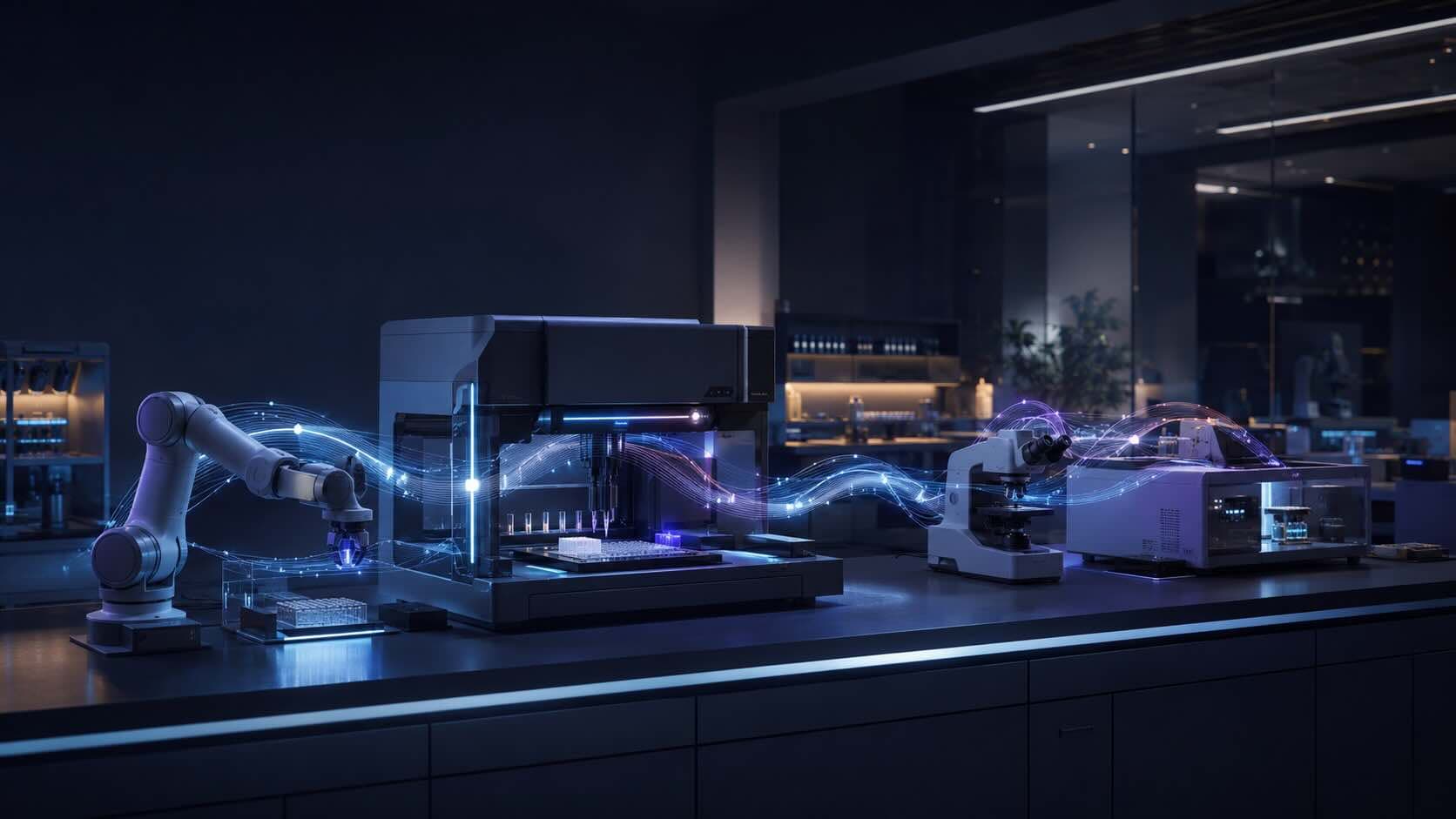
On 27 August, the company opened a research preview of the Model Hardware Standard, known as MHS. It is a shared specification designed to let AI agents operate programmable physical equipment. Early examples include microscopes, liquid handlers, robotic arms, laboratory cameras and laser systems used in quantum computing.
The announcement matters because it targets one of the least glamorous but most important barriers to Physical AI: machines from different manufacturers often cannot communicate with one another without custom software. MHS proposes a common layer through which an AI agent can discover equipment, understand what it can do, read its condition and issue commands within defined limits.
If this approach works at scale, the transition from AI assistant to AI operator may not begin with a humanoid robot. It may begin with a standardised driver inside a laboratory.
The problem is not intelligence alone
Modern laboratories and factories already contain sophisticated equipment. The difficulty is often connecting it.
One microscope may use one programming interface. A robotic arm may use another. A plate reader may rely on older software, while a third machine may only expose controls through a graphical screen. Specialists must then write separate integrations and build a coordination layer between them.
Anthropic says this work can take weeks or months. In some of its early MHS projects, the company says the same integration work was reduced to hours or minutes. Reuters reported that the standard is intended to work with any device that has a programmable interface and to support communication between devices and agents across networks.
This is why MHS may be more consequential than another impressive robot demonstration. Better models are useful, but intelligence cannot act reliably if every machine speaks a different technical language. Physical AI also needs infrastructure.
How MHS works
MHS introduces a standardised software driver between an AI agent and a physical device. The driver translates basic operations into a common set of instructions. A command may be as simple as reading a temperature or setting a temperature.
The system also creates a structured description of each connected device. This can include what the machine measures, which settings can be changed, its physical characteristics and the safety limits that must be enforced. Information that once lived in paper manuals, files or the memory of an experienced operator can therefore become available to the agent in a consistent form.
The result is not that every machine suddenly becomes identical. Instead, each device presents its capabilities through a shared interface.
An agent can then:
Discover available equipment.
Read the current state of each device.
Understand which operations are permitted.
Sequence tasks across several machines.
Monitor results as conditions change.
Adjust parameters within defined limits.
Convert a successful procedure into deterministic code.
That final step is especially important. Anthropic describes cases in which Claude explored a physical task, observed the result of each adjustment and then wrote a conventional script that could repeat the successful procedure. The model was used to discover the process, while the production task could later run through inspectable code without continuous AI control.
MHS is also independent of a single AI model. Anthropic says different agent systems can access it through standard mechanisms, including the Model Context Protocol, command line tools and application programming interfaces. This gives MHS the potential to become an ecosystem layer rather than merely a Claude feature.
Early evidence from real equipment
The research preview includes several useful proofs of concept.
At Carnegie Mellon University, researchers used MHS to coordinate a liquid handler, plate reader, robotic arm and monitoring cameras distributed across three computers with incompatible interfaces. Anthropic reports that the team built the drivers and orchestration layer in about eight hours, compared with the several weeks normally associated with a vendor built setup. The resulting dose response experiments ran roughly three times faster.
At QuEra Computing, an agent used MHS while developing a controller for a laser system inside a neutral atom quantum computer. The final deterministic script recovered the laser's precise operating frequency in 695 of 700 blind trials, a reported success rate of 99.3 per cent. More importantly, the final production script no longer required an AI agent to control the laser. The experiment shows how an agent may help search for a better operating procedure, then hand the result back as auditable software.
At the University of Washington, one researcher connected six laboratory instruments in less than a week. The equipment could then report its status through one dashboard and coordinate the handover of sample plates between a liquid handler and a robotic arm.
These results are promising, but they come from Anthropic and participating partners. They are early demonstrations rather than independent proof that MHS is ready for broad industrial deployment. Reliability across a small number of selected systems does not yet establish reliability across thousands of laboratories, factories and hardware configurations.
From automation to a closed scientific loop
Traditional automation follows a procedure that a human has already defined. An AI operated laboratory could go further.
A researcher might provide a scientific goal. The agent could select parameters, operate instruments, inspect the results and decide what experiment should happen next. Data would no longer leave the physical workflow for a separate period of analysis. The result of one experiment could immediately shape the next.
This creates a closed loop:
Hypothesis → experiment → measurement → analysis → revised hypothesis → next experiment
The commercial and scientific implications are significant. Laboratories could run for longer periods, use scarce equipment more efficiently and test more variations. Advanced manufacturing systems could identify faults and adjust processes in real time. Smaller research teams might gain access to forms of automation that currently require specialised engineers and expensive integration projects.
The deeper shift is in the role of the model. The AI is no longer only interpreting information produced by the world. It is helping decide which information the world should produce next.
The physical world exposes the limits of AI
MHS does not solve physical reasoning.
Anthropic's own Genentech example provides the clearest warning. During a liquid handling experiment, Claude encountered errors caused by bubbles and foam. Its first response was to retry the operation with different settings in the same well. That made the liquid more agitated and created more bubbles. Human specialists had to explain the physical cause and guide the model towards a gentler procedure.
This distinction matters. A language model learns mainly from text, images and recorded data. It does not experience viscosity, vibration, friction or fragility in the way a laboratory worker does. A machine may describe its status correctly while the model still misunderstands the physical reason for that status.
The risk also grows with autonomy. A failed software task can often be reversed. A damaged biological sample, collision between machines or unsafe movement cannot always be undone.
Anthropic is therefore limiting MHS to selected research partners while safety evaluations and deployment practices are developed. The company says it intends to publish findings when the standard becomes open source. MHS also allows device level safety limits to be documented and enforced, but guardrails are only one part of the problem. Safe operation will require reliable hardware controls, permission boundaries, monitoring, audit logs, emergency stops and clear human responsibility.
As WIRED noted, giving agents access to physical systems creates risks of equipment damage and human harm that do not exist in ordinary chatbot use.
AI Analysis: the standard may matter more than the machine
The most important part of this announcement is not that Claude moved a robot arm or adjusted a laser. Similar demonstrations will become increasingly common.
The strategic signal is that Anthropic is trying to define the interface through which many models and many machines could meet.
Standards can create value because they reduce repeated work. If manufacturers adopt a shared specification, developers no longer need to build every connection from the beginning. Hardware becomes easier to discover and combine. Software can address a broader installed base. New services can emerge above the common layer.
This resembles the logic behind Anthropic's Model Context Protocol, which created a standard way for AI systems to connect with software tools and data sources. MHS attempts to extend that idea into physical equipment, but the stakes are higher because every instruction may have a real world consequence.
Early support from AWS, Automata, Doosan Robotics, QIAGEN, Tecan, Universal Robots, Hugging Face and Raspberry Pi strengthens the ecosystem signal. It does not guarantee adoption. Competing standards may emerge, equipment manufacturers may protect proprietary interfaces, and regulated industries may move slowly. Many machines also lack a usable programming interface and cannot yet participate.
The evidence therefore supports a cautiously positive conclusion. MHS is not yet the operating system for Physical AI. It is an early proposal for one of the layers such a system will need.
What to watch next
Four developments will show whether MHS is becoming durable infrastructure rather than an interesting preview.
First, hardware adoption. The number and variety of supported devices will matter more than the number of demonstrations.
Second, independent evaluation. External researchers must be able to reproduce the reported integration and reliability gains.
Third, safety architecture. The eventual open source release should explain permissions, failure handling, auditability and how physical limits are enforced.
Fourth, model diversity. A genuinely shared standard should work well across competing models and agent systems, not only within Anthropic's own ecosystem.
Conclusion
Physical AI is often represented by the visible machine: the humanoid, the robot arm or the autonomous vehicle. MHS points to a less visible part of the transformation.
Before AI can operate the physical world at scale, it needs a dependable way to understand what each machine is, what it can do and where it must stop.
Anthropic has not solved that problem. It has identified the right layer and produced early evidence that a common interface can shorten integration, improve coordination and support closed experimental loops.
That makes MHS one of the most important Physical AI signals of 2026. Not because it proves that autonomous laboratories have arrived, but because it shows what their connective tissue may look like.
AI Sentiment
sentiment_score: 0.82
financial_sentiment: Cautiously positive
polarity: 0.67
subjectivity: 0.28
confidence: Medium
The technological direction is strongly positive, supported by credible early partners and concrete experiments. Confidence remains moderate because the preview is limited, most performance claims are reported by Anthropic and its collaborators, and broad adoption has not yet been demonstrated.
Read More
Reuters: Anthropic unveils framework for AI agents to operate physical devices
WIRED: How Anthropic thinks AI agents should navigate the physical world
Disclaimer
This article is for information and analysis only. It is not investment advice.