
The most important event at Beijing’s World Humanoid Robot Games may not be the 100-metre sprint. It may be a robot trying to plug in a cable.
24 August 2026
Sources: Reuters, World Athletics, Beijing Municipal Government
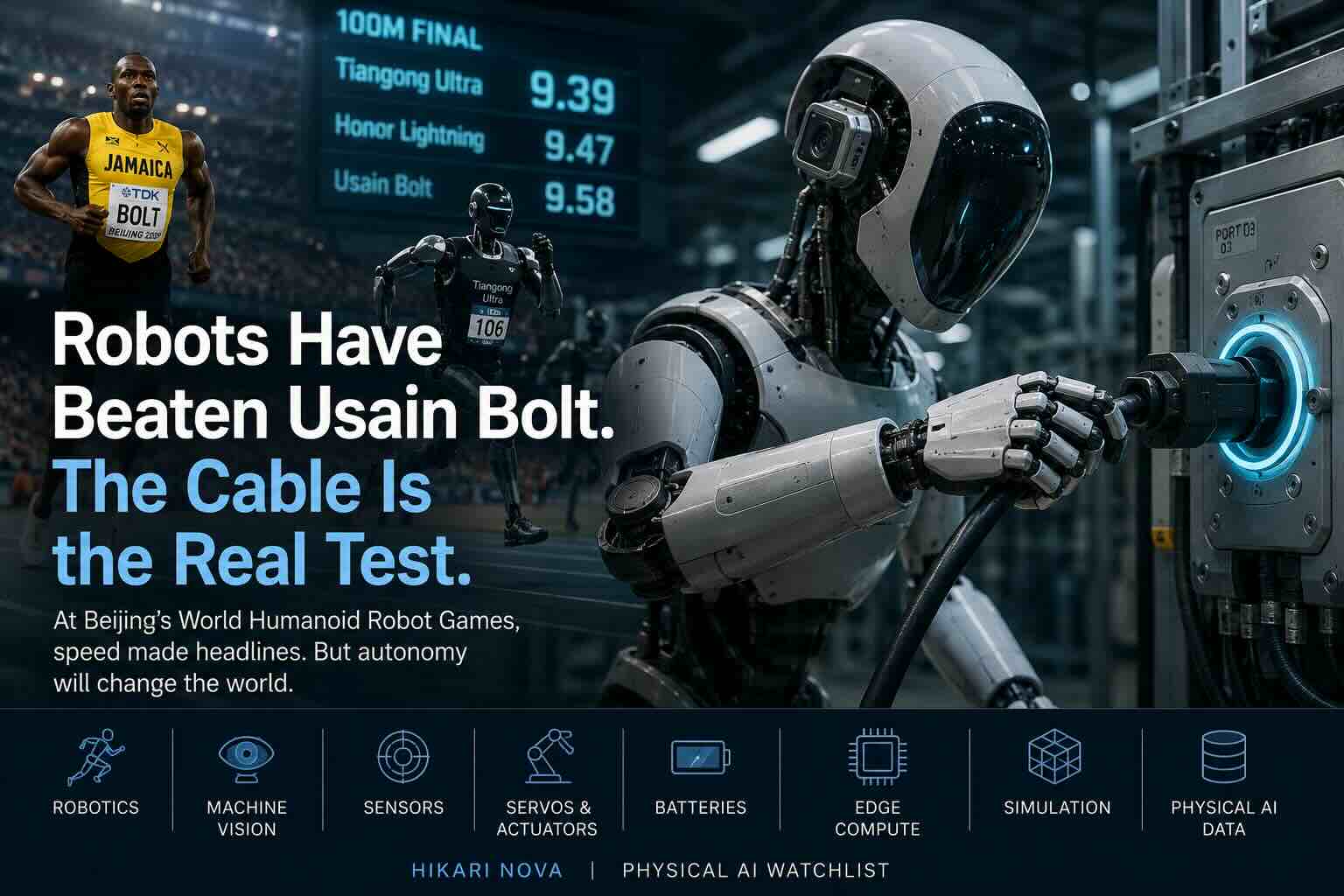
At the World Humanoid Robot Games in Beijing, a humanoid robot called Tiangong Ultra covered 100 metres in 9.39 seconds.
Honor’s Lightning followed in 9.47 seconds.
Both times were faster than the 9.58-second human world record set by Usain Bolt in Berlin in 2009. Lightning had also reportedly recorded 9.32 seconds during a preparatory test before the Games.
That is an extraordinary engineering achievement.
But it may not be the most important thing happening in Beijing.
The more consequential tests are taking place away from the running track, where robots are being asked to recognise objects, handle packages, assemble components, work in simulated restaurants and industrial environments, respond to emergencies and perform precision tasks such as connecting a cable.
And that distinction matters.
Running Fast Is Not the Same as Being Useful
A robot running 100 metres faster than a human is visually spectacular.
It is also a relatively constrained engineering problem.
The robot knows where it needs to go. The track is predictable. The objective is clear. The environment changes very little.
The physical world outside the track is different.
A cable may be lying at an unexpected angle.
A box may have shifted slightly.
An object may be positioned a few centimetres away from where the robot expected it.
A connector may require precisely controlled force.
A previous movement may fail and the robot must understand what happened, correct its position and try again.
Reuters describes exactly these kinds of imperfections as some of the more revealing tests at the Games. A cable connection challenge, for example, combines machine vision, mechanical alignment and force control.
Humans perform thousands of such corrections every day without consciously thinking about them.
For robots, they represent one of the hardest problems in artificial intelligence.
The Real Benchmark Is Autonomy
The 2026 World Humanoid Robot Games have expanded substantially.
The programme contains 51 events, including 30 competitive events and 21 scenario-based tests. Beijing says 666 teams and 2,056 robots have registered for the Games.
More importantly, Reuters reports that more than 40% of the events require robots to operate fully autonomously, according to Huawei, a technology partner to the Games.
That number deserves more attention than the sprint time.
Autonomy changes the engineering problem completely.
A remotely controlled machine can rely on a human to recognise unexpected situations and decide what to do next.
An autonomous robot cannot.
It must perceive the environment, interpret what it sees, plan a movement, execute it, determine whether the action succeeded and recover when it did not.
That loop is the foundation of what is increasingly described as physical AI or embodied intelligence.
And it is where robotics begins to move from demonstration towards economic infrastructure.
From Generative AI to Physical AI
The first major wave of modern AI largely operated inside computers.
Models generated text, software, images, music and analysis.
Physical AI moves intelligence into machines that interact directly with the physical world.
That introduces an entirely different technology stack.
A capable autonomous robot needs perception through cameras and sensors. It needs computing close enough to the machine to make decisions with very low latency. It needs actuators, motors, precision gear systems and force control to translate decisions into movement.
It needs batteries and power electronics.
It needs simulation environments where millions of situations can be practised before the robot encounters them in reality.
And increasingly, it needs large quantities of physical-world training data showing how objects, people and environments behave.
The robot itself is therefore only the visible end product.
Behind it sits an emerging industrial ecosystem.
China Is Building More Than Robots
The Beijing competition should also be viewed in the context of China's broader industrial strategy.
China's 2026–2030 Five-Year Plan identifies robotics as a strategic emerging industry, while embodied artificial intelligence is being promoted as an important future technology with applications across manufacturing and the wider economy.
Training facilities in Beijing are already recreating homes, supermarkets, offices and industrial environments where robots repeatedly practise physical tasks.
Crucially, the objects are deliberately moved and rearranged so that the machines cannot simply memorise a fixed sequence.
They must learn to deal with variation.
That may be one of the most important clues to where the industry is heading.
The goal is no longer simply:
Can the robot perform the task?
The question is becoming:
Can it still perform the task when the environment changes?
That Is Where the Labour-Market Question Begins
Humanoid robots have been discussed as a potential replacement for human labour for years.
But demonstrations are not deployment.
A robot that performs perfectly under controlled conditions but stops when a box moves five centimetres is not yet a general-purpose worker.
The economically important threshold comes later.
A commercially useful machine needs to perform tasks repeatedly, in environments that were not perfectly prepared for it, while requiring little human intervention.
It must also do so at an acceptable cost per task, energy consumption, failure rate and uptime.
This is why the ability to recover from mistakes may ultimately matter more than raw physical performance.
The labour-market impact of robotics will not suddenly begin because a humanoid runs faster than Usain Bolt.
It becomes much more significant when robots can reliably handle the small irregularities that define ordinary workplaces.
The Investment Opportunity May Be Below the Robot
This also suggests a different way of thinking about the robotics investment theme.
The obvious question is:
Which humanoid robot company will win?
That may not be the most useful question yet.
The emerging Physical AI ecosystem contains several layers that could grow regardless of which robot brand ultimately dominates.
A broader Physical AI framework could include:
Machine vision
Cameras, depth sensing and perception systems that allow machines to understand their surroundings.
Sensors
Force, torque, tactile, inertial and positional sensing.
Actuation and motion control
Motors, servos, reducers, linear actuators and precision mechanical systems.
Power and batteries
High-density batteries, power electronics, charging systems and thermal management.
Edge compute
Processors capable of running increasingly sophisticated AI models directly on robots.
Simulation
Virtual environments for training machines across millions of situations before deployment.
Robotics data
Physical-world datasets needed to train machines to understand objects, movement and interaction.
Industrial integration
The software and infrastructure connecting robots with warehouses, factories and existing automation systems.
China's existing strength in electric vehicles, batteries, electronics, motors, sensors and industrial automation gives it an unusually deep supply chain from which this ecosystem can develop. Chinese industry sources already describe extensive overlap between humanoid-robot components and technologies developed for automotive and industrial automation.
The Metrics That Matter Next
The Beijing Games show how quickly physical performance can improve.
Tiangong Ultra won the 100 metres at the inaugural Games in 21.50 seconds in 2025.
One year later, it ran 9.39 seconds.
That rate of improvement deserves attention.
But the next milestones should not only be measured in seconds.
For investors, the more useful indicators may increasingly be:
Autonomous task completion rate
Human interventions per operating hour
Failure and recovery rate
Cost per completed task
Operating hours between failures
Energy consumed per task
Number of different tasks a single platform can perform
Deployment numbers in real commercial environments
When those metrics begin improving as quickly as the sprint times have, the economic implications become considerably larger.
Hikari Nova Analysis
Signal Strength: ★★★★★
The 9.39-second sprint is the headline.
The expansion of autonomous scenario testing is the signal.
Physical AI appears to be moving from isolated demonstrations towards increasingly structured testing of useful real-world capabilities.
The evidence does not yet prove mass commercial readiness. Reliability, operating economics, safety and the ability to function across genuinely unstructured environments remain critical uncertainties.
But the direction is becoming clearer.
AI is beginning to move beyond the screen.
The next major technology platform may not simply generate information.
It may perceive, decide and act in the physical world.
And when assessing that transition, watching a robot plug in a slightly misaligned cable may tell us far more than watching one beat Usain Bolt.
Hikari Nova Opportunity
Physical AI Watchlist: ★★★★½
Rather than attempting to predict which humanoid startup becomes the dominant platform, Hikari Nova could track the infrastructure developing underneath the sector:
Robotics → Machine Vision → Sensors → Servos → Actuators → Batteries → Edge Compute → Simulation → Physical AI Data
The objective would not be to follow the most impressive robot demonstration.
It would be to identify which parts of the Physical AI stack begin showing persistent demand, falling costs, higher deployment volumes and improving commercial economics.
That may provide a much stronger signal than the robot race itself.
Disclaimer
This article is for informational and educational purposes only and does not constitute investment, financial or trading advice. Market conditions, technologies and business models can change rapidly, and past or projected performance does not guarantee future results.