
The AI race has largely been described as a competition for models, chips and intellectual property. But a growing stream of executives travelling to China suggests that another competitive advantage may be becoming just as important: the ability to turn technology into physical products at extraordinary speed.
3 September 2026
Sources: Reuters, Shenzhen Municipal Government, China Ministry of Industry and Information Technology
For much of the past two decades, Silicon Valley has been the place executives visited when they wanted to understand the future.
Today, some of them are travelling in the opposite direction.
Investors, entrepreneurs and corporate leaders are increasingly visiting Shenzhen, Beijing, Shanghai, Hangzhou and other Chinese technology centres to see electric vehicle factories, robotics companies, artificial intelligence systems and advanced manufacturing operations first hand.
Reuters reports that specialised technology tours are now attracting executives from Europe, Southeast Asia and the United States. Some five day programmes cost as much as $15,000. Xiaomi's electric vehicle factory in Beijing alone has received more than 250,000 visitors since March 2024.
The attraction is not simply Chinese technology.
It is the speed with which technology becomes industry.
And that distinction may become increasingly important for investors.
Innovation has two very different meanings
The conventional technology narrative tends to define innovation as invention.
A new semiconductor architecture.
A better artificial intelligence model.
A new battery chemistry.
A breakthrough robot.
A patent.
A piece of software.
But there is another form of innovation that receives considerably less attention.
The ability to manufacture something reliably, cheaply and repeatedly.
Not once.
Not in a laboratory.
Not as an impressive prototype.
But hundreds of thousands, or eventually millions, of times.
That changes the equation.
Innovation is not only the ability to invent something new.
It is also the ability to build it at scale.
Reuters' reporting from China suggests that this second definition is becoming increasingly visible to international executives.
One participant in a Chinese technology tour described the importance of seeing the scale, speed and physical nature of Chinese innovation from the factory floor. Shenzhen based manufacturing consultant Joshua Woodard told Reuters that American robotics companies remain heavily dependent on Chinese components and hardware.
This is not merely a supply chain story.
It may represent a different kind of technological advantage.
From software velocity to manufacturing velocity
Silicon Valley became extraordinarily effective at shortening the distance between an idea and a software product.
A small team could create something, release it, observe how people used it, improve it and distribute the new version globally.
Software made iteration extraordinarily cheap.
Physical products historically worked differently.
Factories required large investments. Tooling took time. Supply chains were complicated. Changing a product after production began could be expensive.
But advanced manufacturing is beginning to compress those cycles.
Robotics, simulation, computer vision, autonomous logistics, digital twins and artificial intelligence are gradually bringing something resembling software iteration into the physical economy.
China appears determined to accelerate that transition.
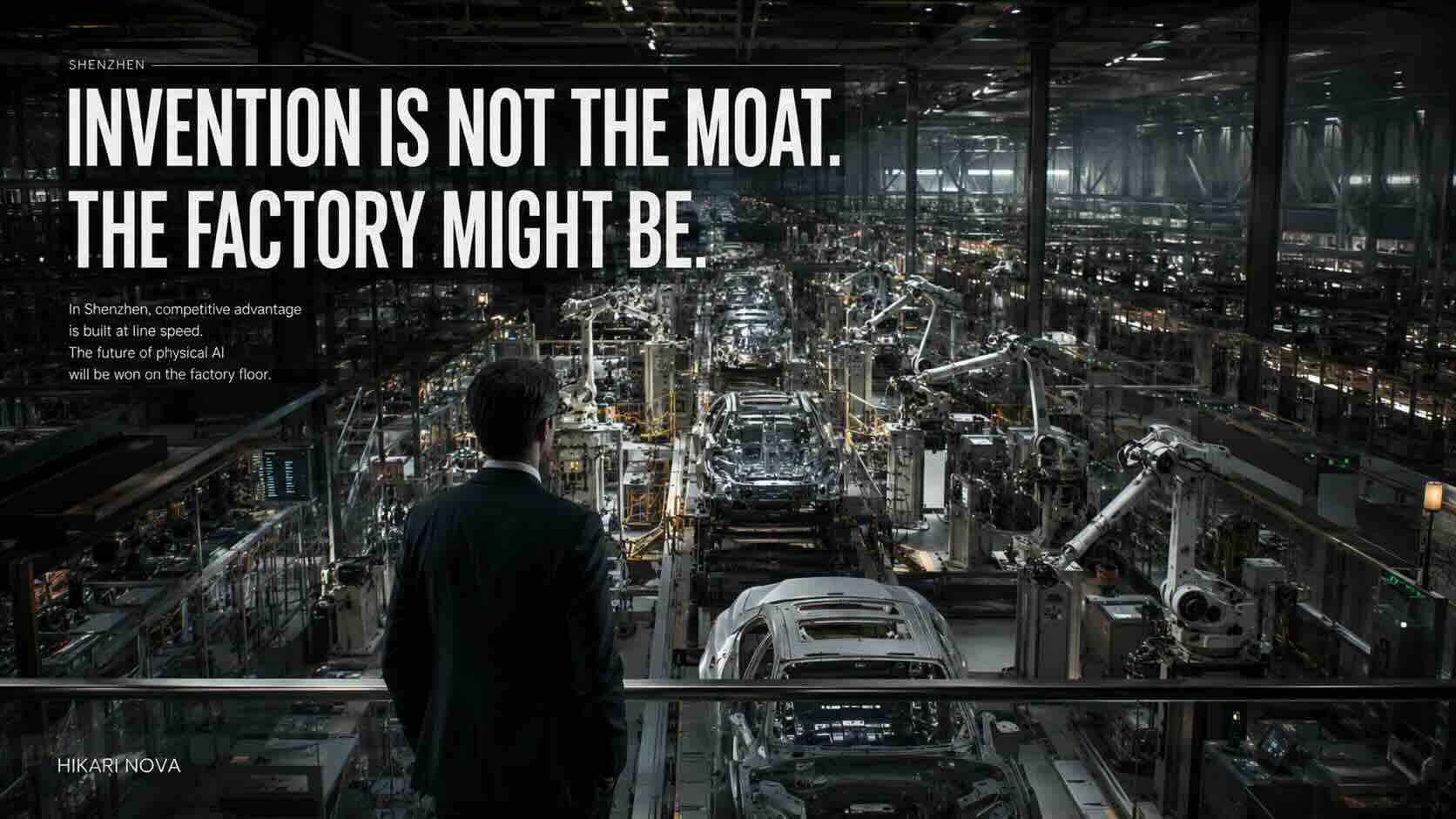
Shenzhen's 2026 to 2027 AI manufacturing strategy explicitly calls for artificial intelligence to be integrated across product design, production planning, factory operations, logistics and supply chains. The plan includes AI based factory simulation, dynamic production scheduling, autonomous mobile robots, machine vision and intelligent inventory management.
That matters because manufacturing itself starts becoming a learning system.
Factories no longer simply manufacture products.
They generate data that can improve the next production cycle.
Design → manufacture → observe → optimise → manufacture again.
The faster that loop becomes, the more powerful the industrial system can become.
Physical AI makes the factory strategically important again
This becomes particularly important as artificial intelligence moves beyond screens.
Large language models primarily operate in the digital world.
Robots, autonomous vehicles, drones and intelligent machinery must operate in the physical world.
They require motors.
Sensors.
Batteries.
Cameras.
Actuators.
Power electronics.
Precision components.
Manufacturing equipment.
And extremely complicated supply chains.
This is where physical AI creates a different competitive environment.
China's Ministry of Industry and Information Technology has already launched a 2026 programme designed specifically to move humanoid robots and embodied AI into real industrial environments. Its goal includes creating more than 100 high value application scenarios and developing the capacity for deployment at a scale of tens of thousands of units.
The important part is not simply that China wants better robots.
It is how those robots are being developed.
Factories, robot manufacturers, component suppliers, AI developers and research institutions are being encouraged to work together in real production environments.
That creates another feedback loop:
AI improves manufacturing.
Manufacturing improves robots.
Robots create more operational data.
The data improves AI.
If successful, this could create a powerful industrial compounding effect.
Shenzhen's real advantage may be proximity
This helps explain why Shenzhen has become such an interesting destination.
According to Reuters, foreign founders are arriving in the city looking for component manufacturers and prototype suppliers. Informal groups connect entrepreneurs moving between Silicon Valley and Shenzhen with battery, display and other hardware factories.
This reveals something easily missed when technology is analysed company by company.
An industrial ecosystem can itself become a competitive advantage.
Imagine two companies developing exactly the same hardware product.
One needs several weeks to identify a supplier, obtain a component, manufacture a prototype and test it.
The other can do the same sequence in several days.
After one year, those companies may no longer have comparable products.
One may have completed dramatically more iterations.
That difference is not visible in a patent database.
It may not appear on a balance sheet.
Yet it can ultimately determine which product reaches the market first and which product improves fastest.
The real metric may therefore be:
Idea → Prototype → Production → Feedback → Improved Product
The shorter that cycle becomes, the greater the potential competitive advantage.
We could call this Manufacturing Velocity.
And it may become one of the most important metrics of the physical AI economy.
The Hikari Nova AI Analysis
From an investment perspective, this changes how the next technology cycle could be analysed.
Much of today's AI investment discussion focuses on three things:
Compute.
Models.
Intellectual property.
Those remain enormously important.
But physical AI may introduce a fourth layer:
Industrial execution capability.
Consider an AI robotics company with exceptional algorithms but no efficient path to manufacturing.
Now compare it with a technically slightly weaker competitor that has access to motors, batteries, sensors, factories, tooling and suppliers within a highly integrated manufacturing ecosystem.
In software, the better algorithm might win.
In physical AI, the answer becomes considerably less obvious.
The ability to manufacture quickly may allow the second company to ship more units, collect more real world data, discover more failures and improve the product faster.
Scale itself starts contributing to technological development.
That means investors may eventually need to ask questions that traditional technology analysis sometimes neglects:
How quickly can this company move from prototype to production?
How tightly integrated is its supplier network?
How quickly can production lines be modified?
How much operational data does manufacturing generate?
Can the company reduce costs as volume increases?
Can it manufacture hundreds of thousands of units without sacrificing quality?
These questions could become increasingly important across robotics, autonomous systems, electric vehicles, batteries, drones and industrial AI.
But there is an important counterargument
China should not automatically be interpreted as the technological leader in every field.
Reuters makes this distinction explicitly.
Rui Ma, founder of Tech Buzz China, notes that non Chinese technology companies still hold much of the global market share, many of the world's most advanced intellectual property assets and some of the industry's largest profits.
China also faces structural challenges.
Geopolitical tensions can restrict access to advanced technology.
Trade barriers can reduce access to foreign markets.
Industrial policy can produce overcapacity.
Aggressive competition can destroy margins.
Rapid manufacturing does not compensate for weak products.
And scale itself is not necessarily evidence of sustainable profitability.
These are important limitations.
The stronger conclusion is therefore not:
China has won the technology race.
It is:
The criteria by which technological leadership is judged may be changing.
The company with the best invention does not automatically become the company that dominates the market.
The winner may increasingly be the organisation or ecosystem capable of combining technology, capital, suppliers, manufacturing and iteration faster than its competitors.
From the Silicon Valley model to the Shenzhen model
During the 2010s, executives travelled to Silicon Valley to understand software platforms, startups, venture capital and digital disruption.
The lessons were frequently about organisational speed.
Build quickly.
Launch quickly.
Measure quickly.
Iterate quickly.
Shenzhen may represent the physical counterpart of that philosophy.
Prototype quickly.
Source quickly.
Manufacture quickly.
Measure quickly.
Improve quickly.
Scale quickly.
This does not replace Silicon Valley.
Nor does it mean the future belongs exclusively to China.
Instead, the next major technology ecosystem may combine both philosophies.
Silicon Valley's software velocity.
Shenzhen's manufacturing velocity.
Artificial intelligence could ultimately connect the two.
The investment signal
The most important lesson from the executives travelling to China may therefore have little to do with tourism.
They are observing a potentially important structural change in technology.
For decades, investors could separate technology companies from industrial companies relatively easily.
AI is beginning to blur that distinction.
The next generation of major technology companies may manufacture robots, vehicles, autonomous machines, energy systems and intelligent infrastructure.
Their competitive advantage will not live entirely inside software.
It will exist inside factories too.
And as artificial intelligence moves from the screen into the physical world, the factory may once again become one of the most important places to understand the future.
Hikari Nova Signal: ★★★★★
Structural trend: Physical AI and advanced manufacturing
Investment horizon: Long term
Key signal: Manufacturing velocity
Confidence: High that industrial execution is becoming strategically more important. Lower confidence that any single region will maintain a durable advantage.
AI Sentiment
Positive, with important structural risks.
China's manufacturing ecosystem demonstrates how tightly integrated supply chains, automation and rapid product iteration can accelerate the commercial deployment of new technologies.
For investors, however, production scale should not be confused with profitability or technological leadership.
The strongest long term opportunities may emerge from companies that combine strong intellectual property with exceptional industrial execution.
Read More
Reuters: Tech pilgrims flock to China as global innovation race heats up Read the Reuters report
Shenzhen Municipal Government: AI + Advanced Manufacturing Action Plan 2026–2027
China Ministry of Industry and Information Technology: 2026 humanoid robotics and embodied intelligence industrial deployment initiative.
Disclaimer
This article is for informational and analytical purposes only. It does not constitute investment advice, financial advice or a recommendation to buy or sell any security or asset. Markets and technology sectors involve risk, and future outcomes may differ substantially from current expectations.