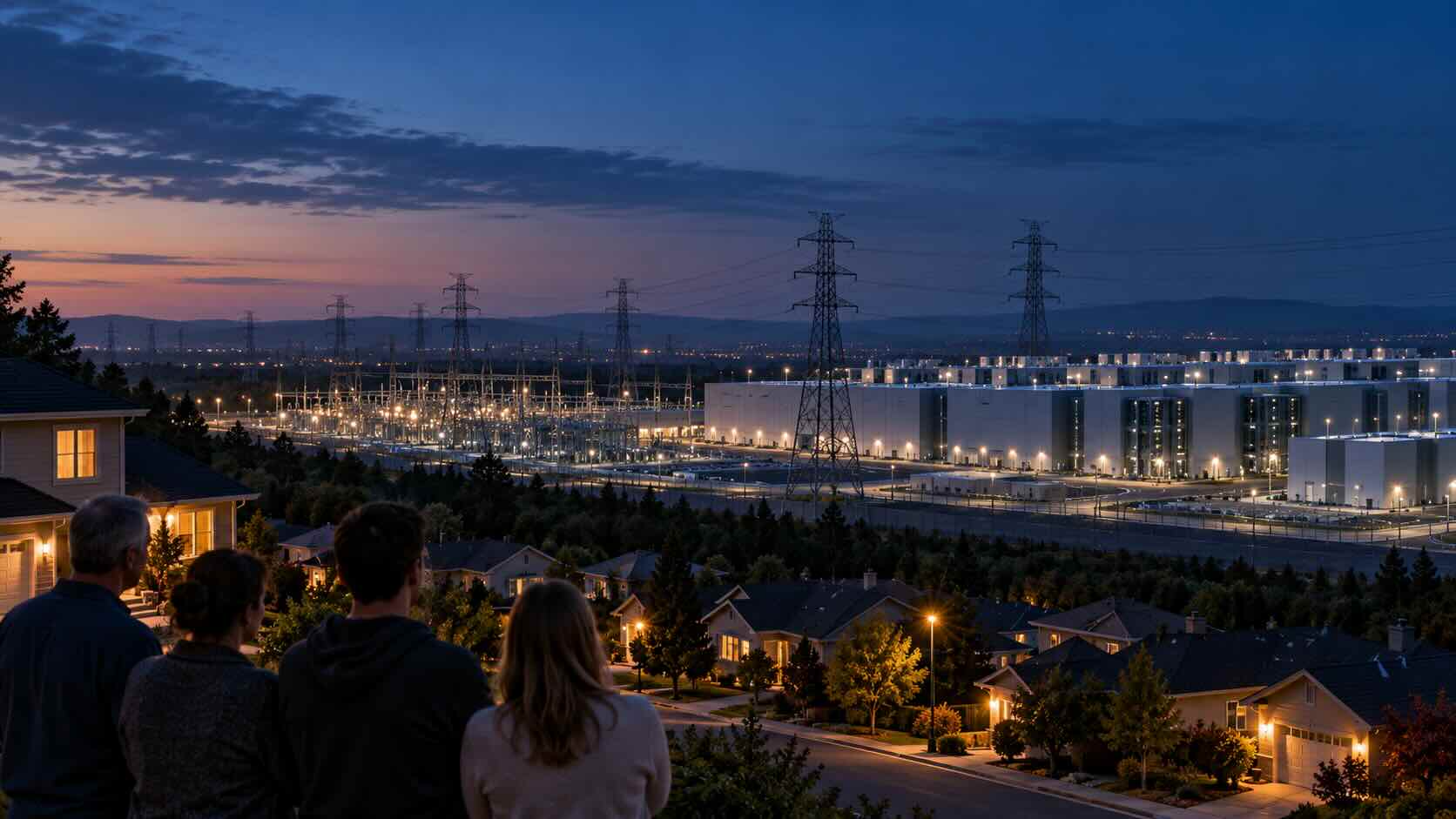
Local opposition over electricity costs, environmental pressure and community impact is adding a political and permitting risk to the infrastructure behind the AI boom.
Market Analysis · 22 October 2026 · 7-minute read
Observation: opposition is becoming an investment issue
Data centres have become a visible part of the AI investment story. They require large amounts of electricity, land and supporting infrastructure. As they spread, communities are asking who pays for the power, who benefits from the investment and what the facilities mean for local life.
Reuters reports that these concerns are becoming more politically salient in the United States ahead of the 2026 midterm elections. Investors are watching national, state and local races because public authorities can affect how quickly data centre projects are approved and built. reuters.com
The political debate is not limited to one party. A Reuters/Ipsos poll cited in the report found that 69% of Democratic registered voters supported limits on data centre construction, compared with 43% of Republicans. The figures point to broader public concern, though they do not by themselves predict how voters or elected officials will act. reuters.com
DVL interpretation: the constraint is moving closer to the ground
The AI investment story is often told through chips, cloud platforms and model releases. But those systems depend on physical facilities, power connections and local approvals.
That creates a more complicated chain:
AI demand → infrastructure investment → local power and land pressure → public response → political and permitting decisions → project timing and cost
The chain matters because a project can remain economically attractive while becoming slower or more expensive to deliver. In the Reuters report, investors and analysts describe the likely near-term risk as disruption to timing and costs, rather than an immediate end to AI infrastructure spending. reuters.com
What investors are watching
Reuters reports that investors are monitoring state and local contests in places including Texas, Ohio and Pennsylvania, as well as races in several other states where substantial data centre investment is planned. Local authorities can influence approvals and restrictions, while state-level decisions may shape the wider development environment. reuters.com
At the federal level, a change in congressional control could bring more hearings and investigations into AI and data centre development. Reuters’ reporting also indicates that analysts see significant national restrictions as uncertain: political scrutiny may rise without necessarily stopping construction. reuters.com
That distinction is important for investors. Headlines about political opposition can affect expectations before they change a company’s revenue or project economics. Over time, however, repeated delays, higher connection costs or tighter local conditions could affect where capacity is built and how quickly it becomes operational.
The counterweight: demand and competition remain powerful
The backlash is a real risk, but it is not the whole investment picture. Companies continue to invest in data centres because they expect demand for AI computing and cloud services to grow. Reuters reports that spending on data centres and other AI infrastructure is expected to exceed $1 trillion next year. That is an expectation, not a guarantee of returns. reuters.com
There are also reasons governments may be cautious about measures that substantially slow development. AI infrastructure is tied to economic growth and competition with China. Political leaders may seek concessions for local communities or greater oversight while still supporting investment.
The result may be a more selective buildout. Projects with clearer access to power, credible community arrangements and lower permitting uncertainty could become more attractive than projects that depend on unresolved local negotiations.
Hikari Nova AI Analysis
The data centre debate adds a physical and political layer to AI investment risk. Investors have focused heavily on whether AI demand will justify the large capital commitments made by technology companies. They may also need to assess whether those commitments can be delivered on schedule.
For the AI infrastructure chain, the relevant questions extend beyond the technology itself:
Is electricity available when and where the project needs it?
Can the facility secure approvals without prolonged local conflict?
Are the costs of power and community commitments reflected in project economics?
Can companies shift investment to other locations if a project is delayed?
Will greater oversight clarify the rules, or add uncertainty?
These are analytical questions, not evidence that any particular company or project will fail. The Reuters report supports a view that political and local opposition may disrupt timing and costs. It does not establish the scale of those effects across the industry.
AI Sentiment
Structural sentiment: Positive, with rising execution risk
Near-term valuation sentiment: Cautious
AI ecosystem: Strong investment appetite, alongside greater public scrutiny
Infrastructure outlook: Demand remains important, but delivery depends on power, approvals and local acceptance
Frontier competition: Strategic pressure to build may continue to support investment
Hikari Nova Signal
★★★☆☆
Signal: Local opposition is becoming a material execution risk for AI infrastructure investment.
Structural trend: AI expansion increasingly depends on access to energy, land and predictable approval processes.
Investment horizon: Near to medium term, particularly around project approvals and construction timelines.
Key signal: Political scrutiny may affect the timing and cost of data centre development even if it does not reverse the broader AI investment cycle.
Confidence: Moderate. Reuters identifies a clear political issue and investor concern, but the eventual effect on project schedules and returns remains uncertain.
What would strengthen the signal: More project delays, changes to local approval rules, higher power costs or evidence that developers are moving projects to less contentious locations.
What would weaken the signal: Faster approvals, effective agreements with host communities, improved power availability or evidence that investment continues with little change to project timelines.
Conclusion
The data centre backlash does not yet show that the AI investment cycle is ending. It does show that infrastructure plans can face constraints beyond capital and technology.
For investors, the question is becoming more practical: can companies secure the power, approvals and local support required to turn AI demand into operating capacity? The answer may increasingly shape where the next wave of infrastructure is built, how quickly it arrives and what it costs.
Source: Reuters, “Investors see risk from US midterms to AI trade as data center backlash builds”, 22 October 2026.
Sources
Reuters, “Investors see risk from US midterms to AI trade as data center backlash builds”, 22 October 2026.
Disclaimer
This article is for informational purposes only and is not financial or investment advice. Investing involves risk, and capital can be lost.