
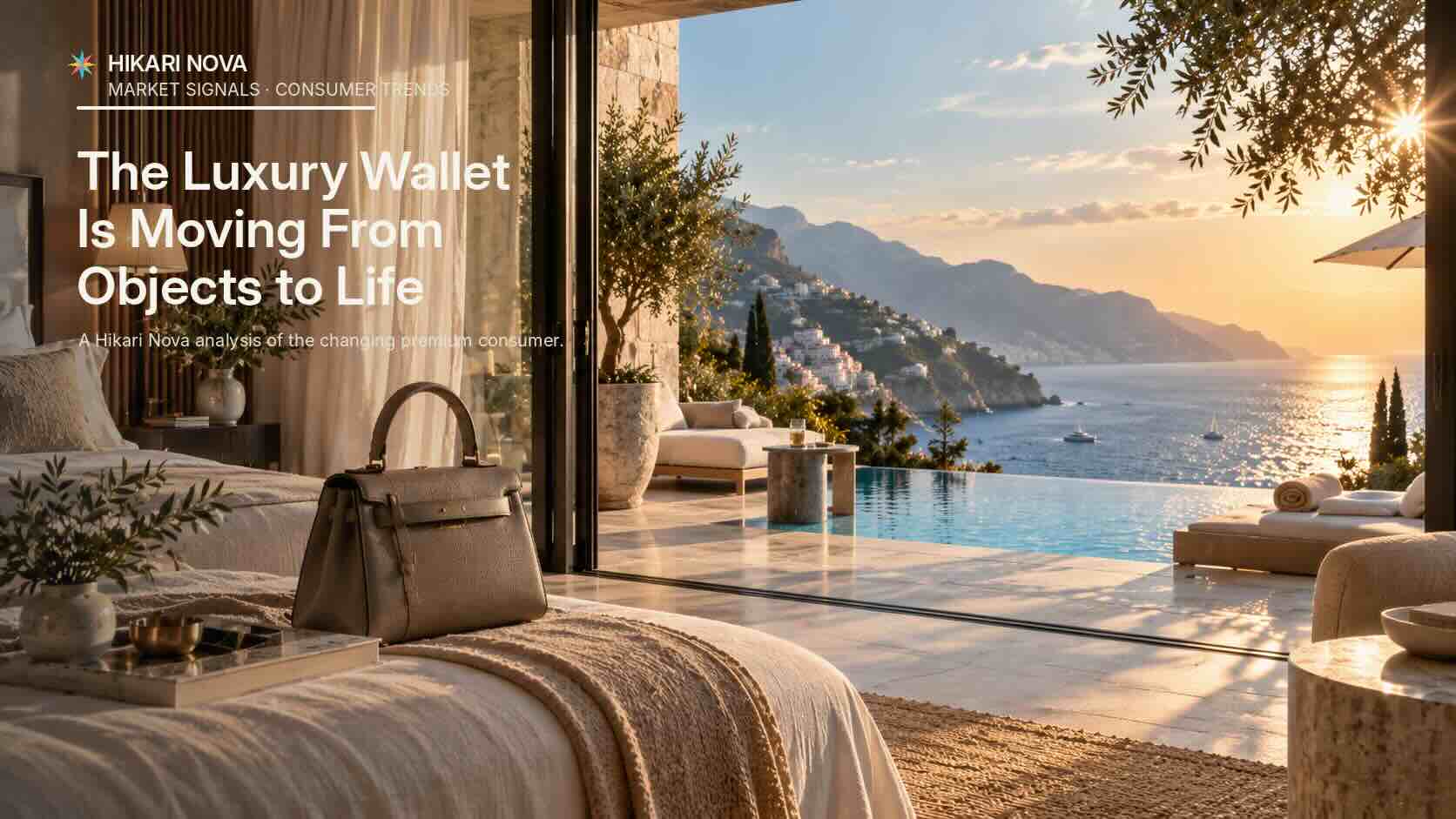
The luxury slowdown may not just be a cycle. It may be a change in what affluent consumers believe is worth paying for.
For decades, the economics of luxury followed a remarkably durable formula.
Scarcity created desire.
Status created social value.
Price increases reinforced exclusivity.
But something is changing.
As Milan Fashion Week opened on 22 September 2026, some of the world's largest luxury groups were confronting a market that looks increasingly difficult to explain as a conventional economic slowdown.
LVMH shares were down about 37% since the beginning of 2026. Kering had erased the gains made after Luca de Meo became chief executive. Deloitte adviser Federico Bazzani told Reuters that fewer than half of luxury brands were growing, while the rest were losing ground.
Inflation, geopolitical uncertainty and weaker aspirational spending are part of the explanation.
But they may not be the whole explanation.
The more interesting possibility is that the luxury consumer's definition of value is changing.
Observation: the consumer is questioning the price
Luxury groups have spent years increasing prices.
That strategy worked particularly well when demand was expanding rapidly and wealthy consumers were relatively insensitive to increases.
The problem comes when price rises faster than perceived value.
Reuters reports that even wealthy clients are increasingly questioning whether luxury products still offer sufficient value for money. Middle-class consumers have already reduced discretionary luxury purchases, increasing competition for the wealthiest customers.
BCG's 2026 True-Luxury Global Consumer Insights study provides an unusually strong confirmation of this pressure.
Its survey of more than 10,000 luxury consumers found that 70% had walked away from a luxury purchase because they believed the price was unjustified.
This matters.
Luxury companies historically had an unusual ability to increase prices without significantly damaging demand.
If customers begin actively comparing price against utility, craftsmanship and emotional value, that pricing power becomes less automatic.
The luxury industry has not necessarily lost the customer.
It may have lost the assumption that price itself proves value.
Analysis: the competition is no longer another handbag
The larger change becomes visible when we look at where discretionary spending is moving.
Renzo Rosso, chairman of Diesel owner OTB, told Reuters that consumers are increasingly prioritising wellness, health, longevity, hotels and restaurants.
That statement might be dismissed as anecdotal if it stood alone.
It does not.
Deloitte's Global Powers of Luxury 2026 survey found that 36.2% of luxury executives identified luxury travel as the segment with the strongest growth potential, ahead of every other category included in the study.
McKinsey reaches a similar conclusion from the consumer side.
Its 2026 survey of more than 2,000 luxury consumers in the United States and China found that, when consumers were asked how they would spend additional discretionary income, travel ranked ahead of every luxury product category in both markets.
US luxury consumers showed particular interest in travel and wellbeing experiences.
That means a fashion house is no longer competing only with another fashion house.
It may be competing with:
a boutique hotel,
a private members' club,
a wellness retreat,
a Michelin-level restaurant,
a longevity programme,
a cultural experience,
or an exceptional journey.
This changes the competitive map.
From conspicuous consumption to personal transformation
Knight Frank's 2026 Wealth Report describes the same phenomenon as a transfer of consumption from goods towards experiences, particularly travel, fine dining, hotels and homes.
It also identifies health optimisation, self-improvement and longevity as increasingly important forms of premium consumption.
The underlying shift may therefore be larger than an industry rotation.
Luxury traditionally helped answer the question:
What can I own that signals who I am?
A new form of luxury increasingly answers:
What can I experience, access or become?
The distinction is important.
A handbag is an object.
A wellness retreat can promise transformation.
A watch can communicate status.
A private club can provide belonging.
A luxury car offers ownership.
A rare journey offers memory.
A fashion purchase occupies physical space.
Health, longevity and time can feel almost unlimited in perceived value because the thing being purchased is connected to life itself.
The utility function of luxury may be expanding.
Scarcity is changing too
Traditional luxury relied heavily on manufactured scarcity.
Limited production, controlled distribution and high prices made access difficult.
But McKinsey's research suggests consumers increasingly define exclusivity differently.
In its 2026 luxury study, relatively few consumers said that simple product scarcity was what motivated them to pay full price. Recognition, privileged access, personal relationships and experiences were becoming more important.
This creates a new form of scarcity.
Not:
There are only 500 of these bags.
But:
Very few people can experience this place, receive this access, join this community or spend their time this way.
Time, access, privacy and human attention are difficult to mass-produce.
That may make them particularly powerful luxury assets.
The important counter-evidence
There is a danger in taking the experience thesis too far.
Physical luxury is not disappearing.
BCG's 2026 research explicitly finds that product remains central to luxury purchasing.
Design and aesthetics, craftsmanship and quality of execution, and timelessness and lasting appeal were the three strongest purchase drivers in its research. Logo visibility ranked last.
BCG also expects personal luxury to return to growth, forecasting approximately 2% to 5% growth for 2026 and 4% to 7% by 2029.
Its research therefore suggests something more nuanced than the death of luxury goods.
Traditional luxury categories may continue growing.
But their share of the broader luxury ecosystem could decline.
BCG expects traditional personal luxury categories to move from roughly 80% towards around 60% of the category mix as lifestyle and experiential luxury expand.
That distinction matters enormously.
The structural question is not whether people will stop buying luxury objects.
It is whether the next euro of affluent discretionary spending is as likely to buy an object as it was ten years ago.
The evidence increasingly suggests that it may not be.
Interpretation: the luxury wallet is becoming a portfolio
The modern affluent consumer may effectively be managing a portfolio of personal utility.
Fashion competes with travel.
Jewellery competes with longevity.
A car competes with hospitality.
A watch competes with a private club.
Furniture competes with wellness.
Restaurants compete with almost everything.
The traditional boundaries between luxury sectors therefore become less useful.
The real market is the affluent customer's finite combination of:
money + time + attention.
Winning one increasingly requires winning all three.
This may explain why brands such as Prada are investing more heavily in immersive retail environments, private spaces and hospitality-oriented experiences rather than treating the boutique purely as a transaction point. Reuters reported that Prada's renovated Milan flagship now includes exhibition areas, private shopping rooms, hospitality and spaces designed specifically for top clients.
The store itself is becoming an experience.
That is an important signal.
Hikari Nova AI Analysis
The investment implication is not simply:
sell fashion, buy hotels.
The structural change is more interesting.
If affluent discretionary spending continues migrating towards experiences, transformation and lifestyle ecosystems, businesses capable of monetising time, wellbeing, access, belonging and memorable experiences may capture a growing share of the premium wallet.
Potential areas of structural exposure include:
Luxury hospitality
Premium hotels, resorts and highly differentiated accommodation may benefit from consumers assigning greater value to experiences.
Premium travel
Airlines, private aviation, destination operators and specialised travel companies can increasingly participate in the luxury economy.
Wellness and longevity
Premium fitness, preventive health, diagnostics, recovery, nutrition and longevity services may gradually become luxury categories in their own right.
Restaurants and experiential dining
High-end food is increasingly both consumption and entertainment.
Membership businesses
Private clubs and recurring-access models combine exclusivity, community and predictable revenue.
Luxury real estate
Branded residences increasingly combine hospitality, design, wellness and services rather than competing primarily on physical specification.
Luxury conglomerates that successfully expand into lifestyle
The strongest traditional luxury houses may not lose from this transition at all. They may use their brands to enter hospitality, restaurants, residences, wellness and other experiential categories.
The potential losers are therefore not necessarily fashion companies.
They may be businesses whose value proposition remains dependent on repeated price increases without a corresponding increase in craftsmanship, exclusivity, service or emotional value.
AI Sentiment
Structural sentiment: Positive for experiential luxury
Traditional luxury goods: Neutral to selective
Luxury pricing power: Weakening
High-end consumer demand: Resilient but reallocating
Experiential luxury: Strengthening
The important distinction is between declining luxury demand and changing luxury allocation.
Current evidence increasingly supports the second interpretation.
Hikari Nova Signal
Signal strength: 4.5 / 5
Structural trend: Luxury wallet reallocation
Direction: Objects → experiences, wellbeing, access and lifestyle
Investment horizon: 3 to 7 years
Key signal: Incremental affluent spending is increasingly competing across luxury goods, travel, hospitality, wellness and longevity rather than remaining within traditional product categories.
Confidence: Medium-high
The signal receives a high rating because it is supported by multiple independent datasets and industry studies.
It does not receive a full 5 / 5 because traditional personal luxury remains resilient, top-tier consumers continue buying physical goods and several major research groups expect the sector to return to growth.
What to watch next
The strongest confirmation would not come from Fashion Week.
It would come from capital allocation.
Watch whether major luxury groups increasingly acquire, build or partner with businesses in:
hospitality,
wellness,
longevity,
restaurants,
private clubs,
travel,
branded residences,
and experiential retail.
Also watch the revenue mix.
If experiential categories consistently grow faster than personal luxury goods through the next economic recovery, the industry will have stronger evidence that this is not simply a cyclical slowdown.
It would suggest that consumer utility itself has changed.
Conclusion
Luxury is unlikely to disappear.
Nor is the handbag.
But the most important competitor to the next luxury handbag may no longer be another handbag.
It may be a week in an extraordinary hotel.
A personalised health programme.
A restaurant impossible to book.
Membership in a community.
Access to somewhere others cannot go.
Or simply more time spent living well.
For decades, luxury brands mastered the economics of scarcity.
The next phase may be about something harder to manufacture:
meaningful life.
Hikari Nova Research Note
This article distinguishes between a cyclical slowdown in personal luxury goods and a potentially structural reallocation of affluent discretionary spending. Current evidence supports the existence of the shift, but not the conclusion that experiential spending will permanently replace physical luxury goods.
Sources / Read More
Reuters, 22 September 2026: The show must go on: struggling luxury brands seek catwalk boost in Milan and Paris. Read Reuters
McKinsey, June 2026: The State of Luxury: What US and Chinese clients reveal about the sector's future. Read McKinsey
BCG and Altagamma, July 2026: True-Luxury Global Consumer Insights 2026. Read BCG
Deloitte, 2026: Global Powers of Luxury 2026. Read Deloitte
Knight Frank, April 2026: The evolution of indulgence: a new look at luxury spending. Read Knight Frank
Disclaimer
This article is for informational and analytical purposes only. It does not constitute investment advice, financial advice or a recommendation to buy or sell any security, company or asset. Market conditions and consumer behaviour can change rapidly, and forward-looking interpretations involve uncertainty.