
Investors watch crude oil for inflation signals. A growing shortage in the fuel that actually powers global shipping suggests they may be watching the wrong bottleneck.
Inflation does not always begin where markets are looking.
Sometimes it starts inside a refinery.
A global shortage of fuel oil, one of the fuels that keeps the world's shipping system moving, is developing as refinery disruptions, geopolitical conflict and changing production economics tighten supply.
At first glance, this looks like a specialised corner of the energy market.
It may not stay there.
The more important question is what happens next.
If the fuel used by ships becomes substantially more expensive, the cost of moving goods around the world can rise with it. Those costs can then travel through supply chains, eventually reaching manufacturers, retailers and consumers.
The potential transmission mechanism is simple:
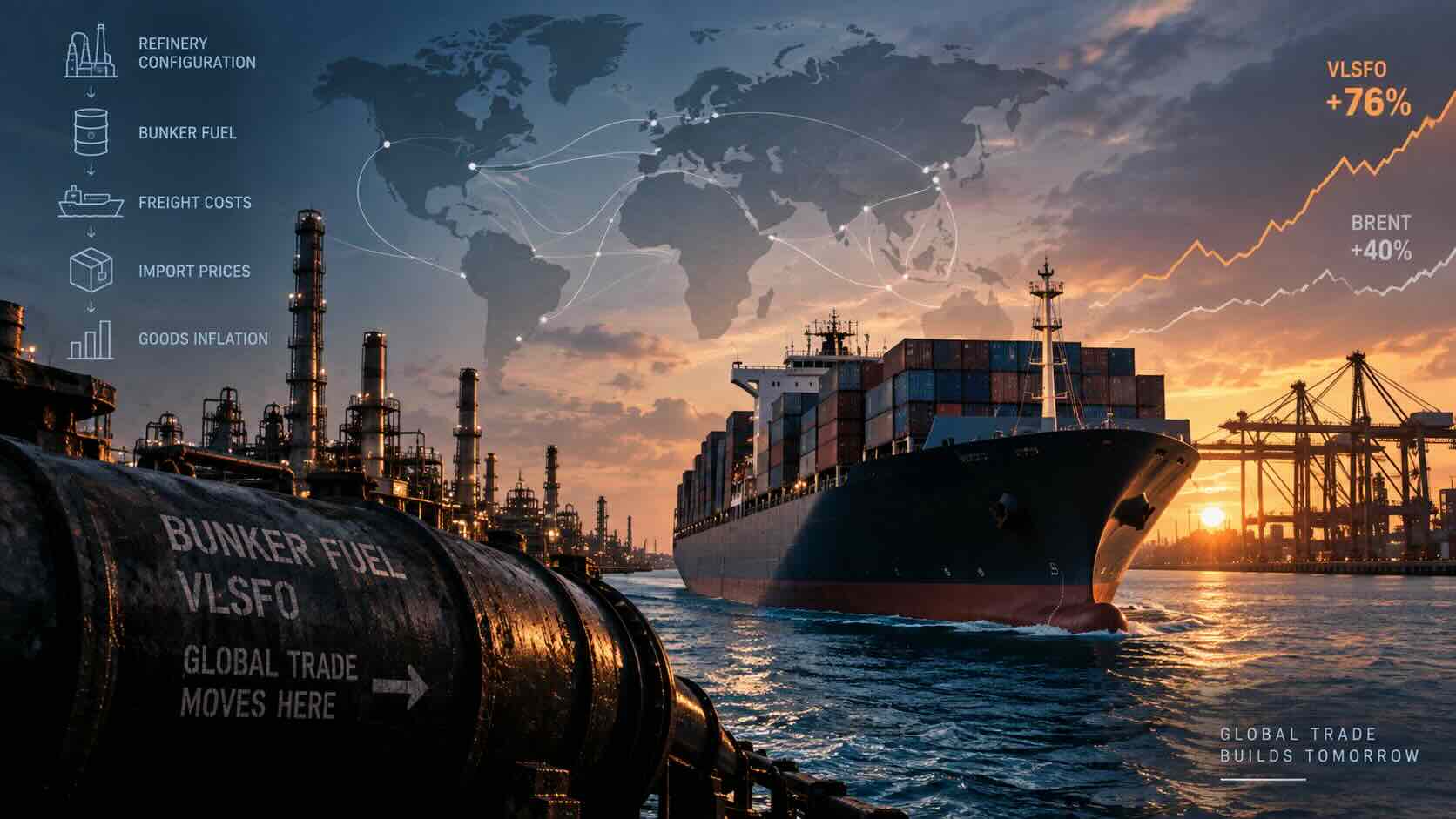
Refinery configuration → bunker fuel → freight costs → import costs → goods inflation
That makes the emerging fuel oil shortage something more interesting than another energy story.
It may be an early example of an inflation signal hiding inside global infrastructure.
The shortage is already visible
Reuters reported on 7 September that the global fuel oil market is expected to face a deficit of approximately 218,000 barrels per day during the third quarter of 2026, according to consultancy Energy Aspects.
A year earlier, the estimated shortfall was only around 6,000 barrels per day.
The change is substantial.
Inventories are also tightening.
Fuel oil stocks across three important trading and bunkering centres, Singapore, Amsterdam–Rotterdam–Antwerp and Fujairah, are approximately 30% below their three-year seasonal averages, according to data compiled by Reuters.
Prices are responding.
Very low sulphur fuel oil, or VLSFO, which is widely used by commercial shipping, had risen 76% since the beginning of the Iran war, reaching just under $825 per metric tonne in Singapore by 1 September.
Brent crude had risen approximately 40% over the same period.
That difference matters.
The refined product required by ships has been appreciating considerably faster than the crude oil from which it ultimately originates.
[Reuters: Ship fuel shortage looms as refiners strained by war favour other products]
Why isn't the market simply producing more?
This is where the story becomes more interesting.
A barrel of crude oil does not automatically become the product the market needs most.
Refineries decide how to optimise their production depending on equipment, available crude, margins and demand.
Right now, several forces are pushing in the same direction.
Wars and attacks on energy infrastructure have disrupted refinery operations in Russia and the Middle East. Tanker movements have also been affected.
At the same time, inventories of products such as diesel and gasoline have become unusually tight.
That gives refiners an economic incentive to prioritise higher-value fuels.
Fuel oil can itself be processed through secondary refining units to produce products such as diesel and gasoline.
The result is counterintuitive.
A shortage of one fuel can encourage refiners to consume more of that same product as feedstock to produce another fuel with better margins.
This can tighten the fuel oil market even further.
Reuters points to Nigeria's Dangote refinery as one example. It has increased exports of diesel, gasoline and jet fuel while reducing fuel oil shipments.
Meanwhile, Russian fuel oil exports fell to a record low of 591,000 barrels per day in August, compared with an average exceeding 860,000 barrels per day during 2025.
Middle Eastern exports fell 45% year on year between March and August.
This is not one broken refinery.
It is a change occurring across several parts of the refining and logistics system.
The second bottleneck: ships are travelling further
There is another pressure building at the same time.
Some vessels are taking longer routes to avoid security risks around the Red Sea and Bab el-Mandeb.
Longer journeys require more fuel.
That creates an uncomfortable combination:
less available fuel + greater fuel consumption per journey.
The supply problem and the logistics problem therefore reinforce each other.
And this matters because maritime transport is not a peripheral part of the global economy.
According to UN Trade and Development, more than 80% of goods traded worldwide by volume are transported by sea.
Container ships, bulk carriers and tankers connect mines, factories, farms, warehouses and consumers across continents.
Shipping is effectively part of the world's economic circulatory system.
When the cost of operating that system changes, the effects can spread much further than the shipping industry itself.
Follow the Bottleneck
Markets traditionally simplify energy-driven inflation into something resembling:
Oil price → energy costs → inflation
That model is useful.
But it can also hide important intermediate constraints.
The current situation suggests another chain:
Refinery disruption
↓
Refiners prioritise diesel, gasoline and jet fuel
↓
Fuel oil availability falls
↓
Bunker fuel prices rise
↓
Shipping operating costs increase
↓
Freight rates potentially rise
↓
Imported goods become more expensive
↓
Goods inflation receives another source of pressure
The distinction matters for investors.
Brent crude could remain relatively contained while individual refined products become significantly more expensive.
That is already visible in the current data.
VLSFO prices in Singapore have risen substantially faster than Brent since the beginning of the Iran conflict.
Watching crude alone could therefore underestimate the stress developing further down the energy supply chain.
Hikari Nova AI Analysis
The important signal is the spread, not simply the oil price
For macro investors, the most useful information may not be that fuel prices are rising.
It is which fuel prices are rising faster than the underlying crude benchmark.
When a refined product materially outperforms crude, it can indicate that the constraint has moved from oil extraction towards refining capacity, product availability or logistics.
That changes what investors should monitor.
A useful signal stack would include:
1. VLSFO versus Brent
If bunker fuel continues appreciating significantly faster than crude, product-specific scarcity is probably still intensifying.
2. Fuel oil inventories
Singapore, Fujairah and Amsterdam–Rotterdam–Antwerp are particularly important hubs to monitor.
Persistent inventories below seasonal norms would strengthen the shortage thesis.
3. Refining margins
Strong diesel and gasoline margins can encourage refiners to continue diverting fuel oil towards higher-value products.
4. Freight rates
This is the crucial transmission layer.
Higher bunker prices alone do not automatically create meaningful consumer inflation.
The signal becomes more important if shipping companies successfully pass those costs into freight rates.
5. Import prices
If freight pressure begins appearing in import-price data, the bottleneck has moved another step towards the consumer.
This creates a potential sequence:
Fuel oil → freight → import prices → CPI
Each stage provides additional confirmation.
What could break the signal?
The inflationary outcome is not inevitable.
This distinction is important.
Shipping companies can absorb some increases through margins. Fuel hedging can delay the impact. Freight markets can weaken if global trade demand slows. Refinery production can recover. Shipping routes can normalise. Alternative fuel grades and operational efficiency can also reduce some pressure.
There is another important limitation.
Transport costs represent only one component of the final retail price of most products.
A large increase in bunker fuel therefore does not translate directly into an equivalent increase in consumer prices.
The strongest version of the thesis requires several things to happen together:
fuel oil remains scarce, bunker prices remain elevated, freight rates respond, importers absorb higher logistics costs and companies subsequently pass enough of those costs to customers.
Until those stages appear, consumer inflation remains a transmission risk rather than an observed consequence.
That distinction matters.
The broader investment lesson
The fuel oil shortage illustrates a larger principle.
Economic shocks frequently begin in places that receive little attention.
A transformer shortage can constrain AI infrastructure.
A shortage of grid connections can delay data centres.
A specialised semiconductor can stop an automotive production line.
And a shortage in a relatively obscure refined petroleum product can increase the cost of moving goods between continents.
The most useful macro question is therefore sometimes not:
What is becoming expensive?
It is:
What does the system require that cannot easily be substituted?
That is where bottlenecks become economically powerful.
Hikari Nova Signal
★★★★★ Strong Structural Signal
Signal: Global fuel oil availability is tightening significantly faster than the broader crude oil market.
Structural trend: Refining constraints and changing refinery economics are creating product-specific shortages inside the global energy system.
Potential transmission:
Fuel oil → bunker costs → freight → imports → goods inflation
Investment horizon: Short to medium term
Primary confirmation: Sustained VLSFO premium combined with rising freight rates.
Secondary confirmation: Higher import prices and renewed goods inflation.
Invalidation: Recovery in refinery output, replenishment of fuel oil inventories, normalisation of shipping routes or falling freight rates despite elevated bunker prices.
Confidence: High that the fuel oil market is currently tight. Moderate that the shortage will become a material global consumer inflation driver.
AI Sentiment
Overall sentiment: Moderately bearish for global inflation conditions
Energy: Bullish
Shipping costs: Bullish risk
Global trade margins: Bearish
Goods inflation: Moderate upside risk
Central-bank disinflation narrative: Moderate downside risk
Signal polarity: Negative
Subjectivity: Low to moderate
The strongest evidence currently concerns the physical fuel market. The inflation transmission mechanism remains an analytical inference that requires confirmation from freight and import-price data.
Conclusion
The world's next inflation problem may not begin with the price of crude oil.
It may begin with what refineries decide to make from it.
A global fuel oil deficit of 218,000 barrels per day is small compared with the enormous scale of the global petroleum market.
But economic importance is not determined by size alone.
It is determined by where a constraint sits inside the system.
Fuel oil occupies an unusually interesting position because it sits beneath maritime transport, and maritime transport sits beneath much of global trade.
For investors, that makes bunker fuel worth watching.
Not because it has already created another inflation wave.
But because it may be showing us where one could begin.
Read More / Sources
Reuters, 7 September 2026: Ship fuel shortage looms as refiners strained by war favour other products.
UN Trade and Development: Shipping data: UNCTAD releases new seaborne trade statistics.
International Maritime Organization: IMO 2020: Cutting sulphur oxide emissions.
Disclaimer
This article is for informational and analytical purposes only and does not constitute investment, financial or trading advice. Market conditions can change rapidly, and forward-looking interpretations involve uncertainty.