

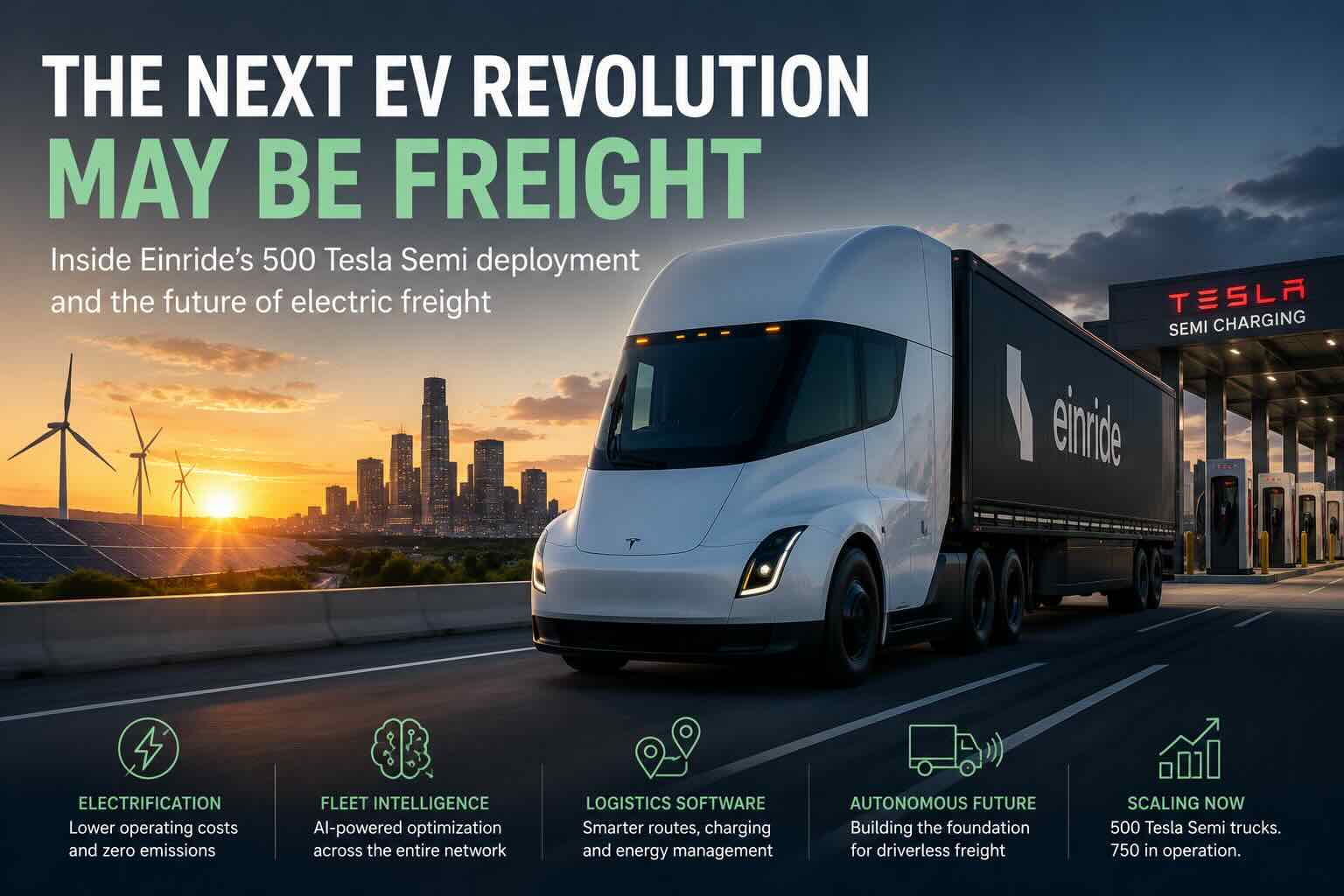
Why Einride’s 500 Tesla Semi Deployment Could Signal a Bigger Shift
August 19, 2026
AI Analysis | Market Signal
Sources: Reuters, Einride, Tesla, International Energy Agency
Signal: ★★★★½
Market Direction: Positive
Strategic Significance: High
Execution Risk: Medium–High
Evidence Confidence: High on deployment — Medium on long-term economics
Electric vehicles have spent most of the past decade being discussed as a consumer story.
Tesla. BYD. Volkswagen. Charging networks. Battery range. Consumer adoption.
But one of the more important electric vehicle developments of 2026 may be happening somewhere much less glamorous:
freight.
Swedish freight technology company Einride announced on August 18 that it plans to deploy 500 Tesla Semi trucks across North America, beginning in September 2026 and continuing in phases over the following 24 months.
The deployment will roughly triple Einride’s deployed electric truck fleet from around 250 vehicles to approximately 750. The trucks will operate for customers including Amazon across freight corridors in California, Texas, New Jersey, Illinois and Georgia. The expansion will be financed using third-party financing rather than requiring Einride to fund the entire fleet directly.
At first glance, this looks like another large electric vehicle deal.
It may be something more important.
The Bigger Story Is Not 500 Trucks
The central question is not whether Einride is buying a large number of Tesla Semis.
It is whether freight transport is approaching a point where electrification, software and scale begin reinforcing each other economically.
Einride’s model combines several layers:
electric vehicles + charging + digital logistics + fleet intelligence + autonomous technology.
The distinction matters.
The 500 Tesla Semis should not be confused with Einride’s autonomous vehicles. Instead, Tesla provides the truck hardware while Einride intends to integrate the vehicles into Saga AI, its fleet intelligence platform.
Saga coordinates variables that become particularly important with electric freight: charging schedules, energy prices, routes, vehicle availability and utilisation.
Einride says Saga AI has already managed more than 19 million electric miles and 42,000 optimisation sessionsglobally. Each additional truck potentially creates more operating data for the system.
That changes the nature of the business.
The truck becomes one component of a larger logistics operating system.
Why Freight Could Be Different From Consumer EVs
Consumer EV adoption depends heavily on emotion and individual preference.
Truck fleets operate under a different logic.
They care about:
cost per mile, uptime, utilisation, maintenance, charging time and return on capital.
That can make commercial transport particularly interesting for electrification.
A small reduction in operating cost becomes much more valuable when a vehicle travels large distances every year.
The International Energy Agency says global electric truck sales doubled in 2025 to more than 400,000 vehicles, reaching 9% of worldwide truck sales. Sales of electric heavy freight trucks almost tripled to approximately 230,000.
China is already demonstrating what can happen when economics, infrastructure and utilisation begin aligning. One in four trucks sold there in 2025 was electric, and the IEA says battery-electric heavy freight trucks have already reached total-cost-of-ownership parity with diesel in some use cases.
That does not mean the same economics automatically apply to North America.
But it demonstrates that electric trucking is moving beyond theoretical feasibility.
Tesla Semi Now Gets a Much Larger Real-World Test
Tesla says the Semi can travel an estimated 500 miles, consume around 1.7 kWh per mile, and recover up to 60% of its range in 30 minutes using Tesla Semi Chargers. Tesla also says deliveries of its new-generation Semi begin in 2026.
Those specifications are significant.
But specifications are not the most important evidence.
Operations are.
A fleet of several hundred trucks running commercial freight routes can begin generating the kind of evidence the market actually needs:
energy consumption under different loads
charging utilisation
maintenance requirements
vehicle uptime
driver productivity
route economics
infrastructure bottlenecks
total cost per mile
That makes Einride's deployment potentially more important than the headline number suggests.
It could become one of the largest real-world tests yet of whether Tesla Semi can operate economically at fleet scale.
Software May Be the Hidden Competitive Layer
There is another reason this development deserves attention.
Electric trucks introduce optimisation problems diesel fleets largely do not have.
A diesel truck can refuel quickly almost anywhere.
Electric freight requires operators to think simultaneously about charging availability, electricity pricing, vehicle range, loading schedules, driver hours and route planning.
That complexity creates an opportunity for software.
Einride CEO Roozbeh Charli told Reuters that access to suitable hardware is reaching the point where software increasingly determines how efficiently the vehicles can be deployed across the network.
This may become one of the more interesting investment themes within transportation.
The value chain could gradually shift from:
truck manufacturer → fleet operator
towards:
vehicle + energy + infrastructure + software + data + automation.
The companies capable of coordinating those layers may capture value that previously belonged primarily to vehicle manufacturers or traditional logistics companies.
Einride Is Betting on Scale
The Tesla announcement arrives as Einride itself attempts to move from technology platform to much larger commercial operation.
Revenue increased 26% year-on-year on a constant-currency basis during the first half of 2026, driven by higher customer volumes and fleet deployment.
The company expects its revenue growth rate to more than double during the second half of the year as deployments accelerate.
Einride is targeting approximately 1,500–2,000 trucks and cash-flow breakeven by 2028.
There is also substantial potential customer demand behind the strategy.
Einride says it has approximately $92 million in expected annual recurring revenue from signed contracts and more than $800 million in potential long-term ARR through joint business plans with customers.
The 500 Tesla Semis are therefore not simply an equipment purchase.
They are intended to turn contracted demand into physical freight capacity.
But This Is Not Yet a Five-Star Signal
The opportunity is significant.
So are the risks.
Einride reported a SEK 1.12 billion net loss for the first half of 2026, although Reuters notes that much of the increase was related to listing, recapitalisation and share-based compensation expenses.
Its shares had also fallen more than 50% since the company's Nasdaq debut before the Tesla announcement.
Electric heavy-duty trucking in North America remains relatively immature.
The IEA estimates that more than 95% of US electric truck sales in 2025 were medium-duty rather than heavy freight vehicles. It also notes that electric trucks can still cost two to three times as much upfront as diesel equivalents in some markets.
Charging infrastructure, vehicle availability, financing, battery weight and residual values remain important constraints.
And the economics Tesla and Einride expect from the deployment still need to be demonstrated at scale.
That is why this remains a ★★★★½ signal rather than ★★★★★.
What Hikari Nova Is Watching
The most important indicator is no longer another announcement.
It is operational evidence.
Over the next 12–24 months, five signals could determine whether this becomes a much larger transportation trend:
1. Fleet utilisation
How many hours per day can electric trucks remain productive compared with diesel?
2. Cost per mile
Do energy and maintenance savings compensate for higher vehicle and infrastructure costs?
3. Charging economics
Can large fleets charge hundreds of trucks without creating expensive operational bottlenecks?
4. Deployment speed
Can Tesla manufacture Semi at sufficient scale and can Einride integrate those vehicles on schedule?
5. Customer expansion
Do companies using the system expand their electric freight commitments after seeing real operating results?
If those indicators improve together, the market may have underestimated how quickly heavy transport can electrify.
The Hikari Nova View
The passenger EV revolution was largely about replacing one drivetrain with another.
The freight transition could become something different.
It may combine electrification, software-defined logistics, energy infrastructure, fleet intelligence and eventually autonomous transport into a single operating system.
That creates potential opportunities far beyond Tesla or Einride.
Charging infrastructure.
Grid equipment.
Battery supply chains.
Power electronics.
Fleet software.
Logistics automation.
Autonomous systems.
Energy optimisation.
Financing.
The important signal from Einride's 500-truck deployment is therefore not simply that another company wants Tesla Semis.
It is that electric freight may finally be approaching the scale where the economics can be tested — and improved — as a system.
The next phase of the EV revolution may not be decided in the driveway.
It may be decided on the freight corridor.
Hikari Nova Signal
★★★★½ — Strong Structural Signal
Why: Large-scale commercial deployment, measurable economics, growing electric truck adoption and a convergence between vehicles, software, energy and logistics.
What would move it to ★★★★★: Demonstrated fleet-level cost advantages, high utilisation, reliable charging operations and additional major customer deployments.
What would weaken the signal: Deployment delays, poor Tesla Semi economics, charging bottlenecks, financing problems or customers failing to expand after initial trials.
This article is for informational and educational purposes only and does not constitute financial or investment advice.