

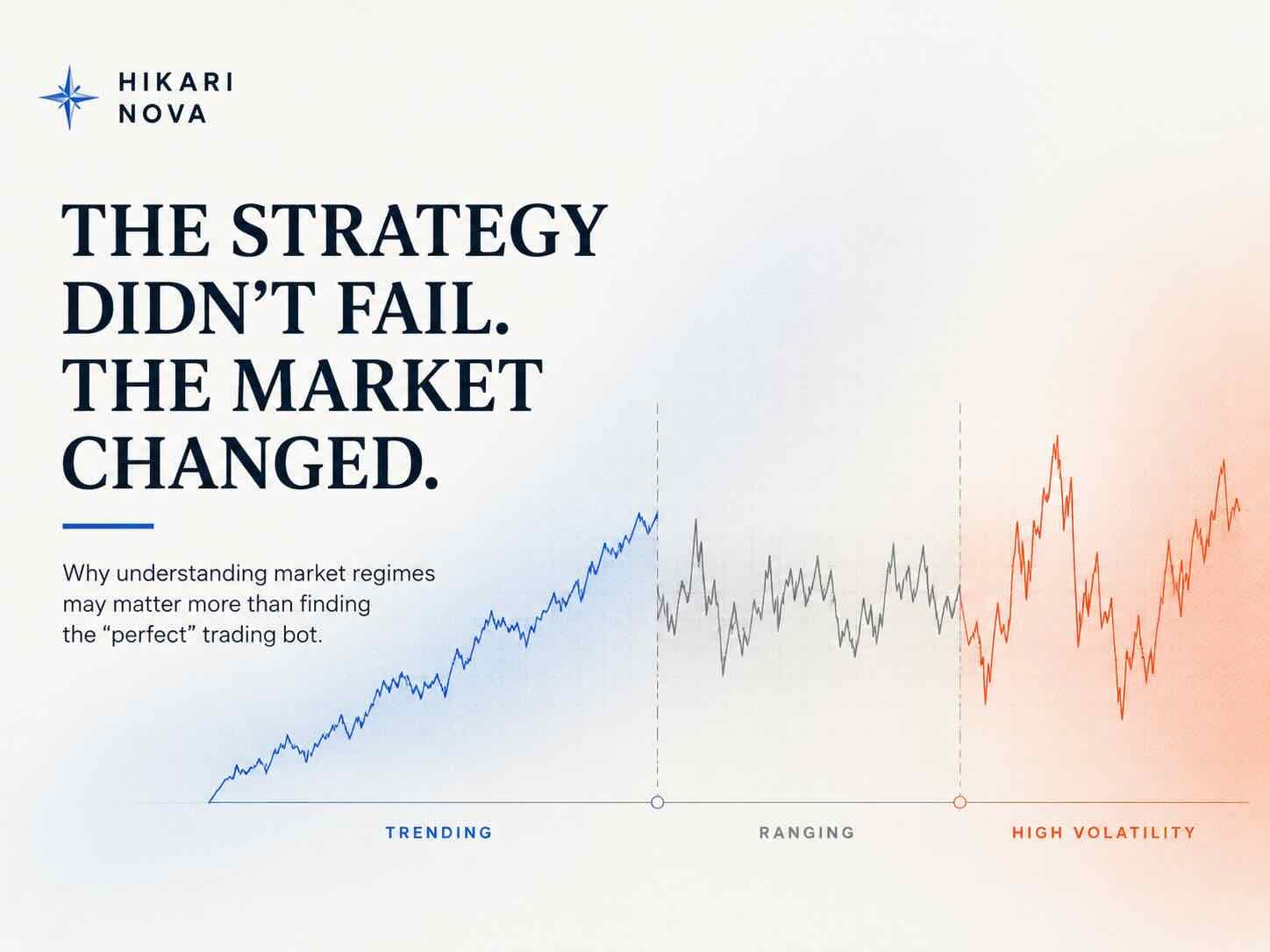
Why understanding market regimes may matter more than finding the “perfect” trading bot.
The Strategy Didn’t Fail. The Market Changed.
Your strategy worked.
Not for a day. Not for a week.
For months.
The signals made sense. The backtest looked convincing. Drawdowns stayed within expectations. The system appeared to be doing exactly what it had been designed to do.
Then something changed.
Trades that once developed cleanly began reversing. Breakouts failed. Stops were hit more often. Signals arrived, but the follow-through disappeared.
The code was the same.
The indicators were the same.
The rules were the same.
The market wasn't.
That distinction is one of the most important ideas in systematic trading.
Markets Do Not Have One Personality
It is tempting to think of a market as a continuous price chart governed by the same underlying behaviour from beginning to end.
Reality is more complicated.
Markets move through periods with very different characteristics.
Sometimes prices develop sustained directional trends.
Sometimes they oscillate within relatively narrow ranges.
Sometimes volatility expands sharply.
Sometimes it contracts.
Liquidity, trading activity, correlations and the strength of momentum can change as well.
Researchers often describe these changing environments as market regimes.
This is particularly relevant to digital assets. Research into cryptocurrency markets has explicitly identified non-stationarity and changing volatility regimes, while more recent work on systematic cryptocurrency strategies evaluates performance separately across bull, bear and sideways conditions.
The important insight is not that markets can be neatly divided into three perfect boxes.
They cannot.
The important insight is that the statistical environment in which a strategy operates changes over time.
Same Strategy. Different Market.
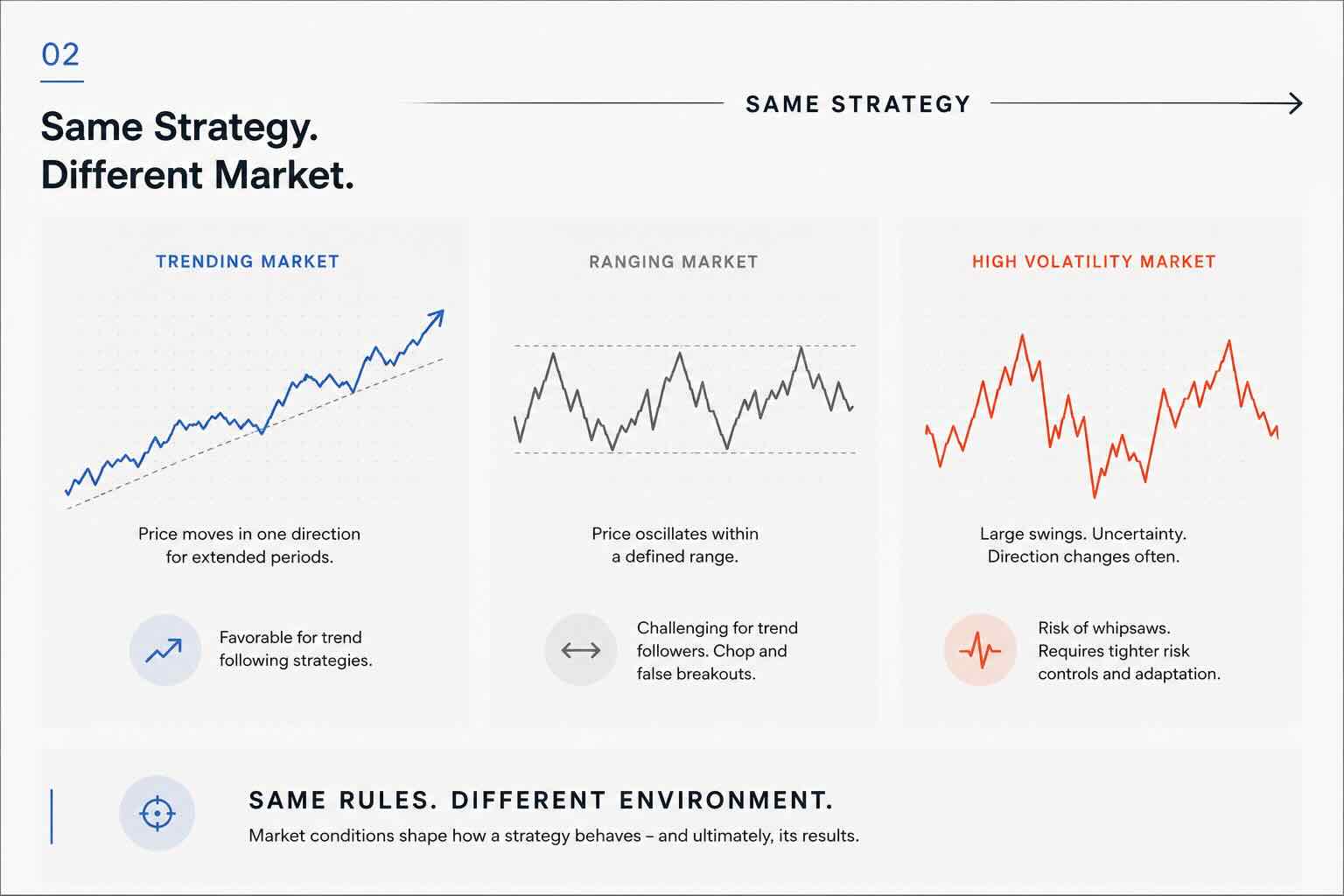
Consider a simple trend-following system.
Its logic might be perfectly reasonable:
Identify directional momentum, enter when that movement becomes sufficiently strong, and remain in the position while the trend persists.
During sustained directional movement, that architecture may have an environment in which its core assumption can express itself.
Now place exactly the same strategy into a noisy market where price repeatedly moves above and below the same levels.
The strategy has not suddenly forgotten its rules.
The environment has changed.
A system designed to capture persistence may instead encounter repeated false starts.
A mean-reversion strategy faces the inverse problem. It may benefit from an environment where deviations repeatedly return towards a more stable centre, yet become vulnerable when what appears to be a temporary deviation develops into a persistent directional move.
Neither observation means that trend following or mean reversion is inherently superior.
It means that strategies contain assumptions about market behaviour whether those assumptions are made explicit or not.
The Hidden Assumption Inside Every Strategy
Every trading strategy is, in some sense, a hypothesis.
A breakout strategy assumes that certain price movements can develop further.
A mean-reversion strategy assumes that certain deviations are temporary.
A momentum strategy assumes that some observed persistence contains information about subsequent movement.
A volatility strategy makes assumptions about how the distribution or magnitude of price movement will behave.
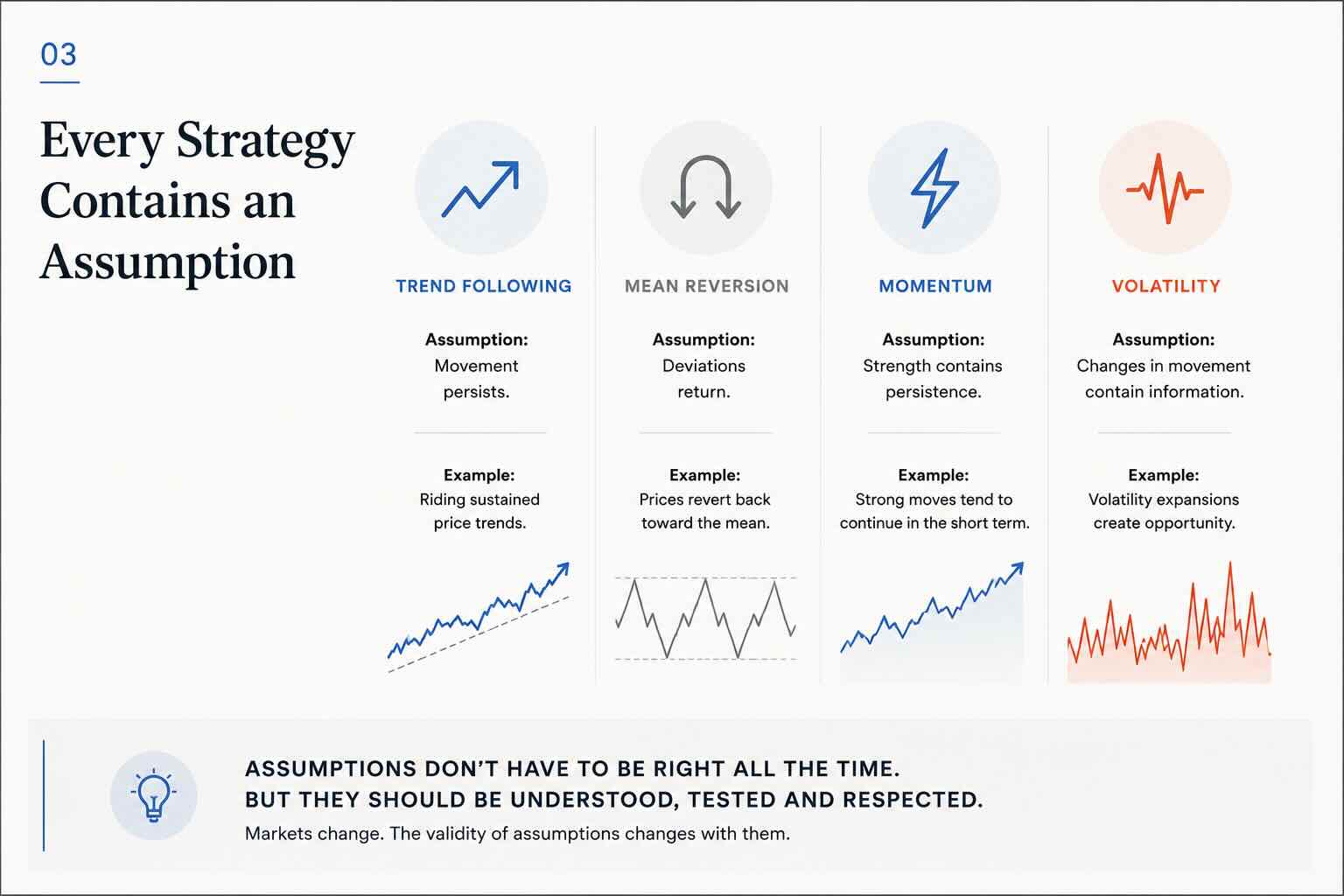
Those assumptions do not have to remain equally valid under every market condition.
This is where the search for the “best strategy” begins to become misleading.
The better question is:
Under what conditions was this strategy designed to work?
That small change in language produces a very different way of thinking about systematic trading.
Instead of asking only:
Did the strategy make money?
we can begin asking:
When did it make money?
What was the market doing at the time?
Where did the drawdowns occur?
What happens when volatility changes?
Does performance survive different periods rather than one favourable historical window?
The strategy stops being a mysterious machine.
It becomes a testable set of assumptions.
Why a Beautiful Backtest Can Hide the Problem
A backtest compresses history.
Thousands of changing market conditions can become one equity curve, one Sharpe ratio, one win rate or one profit factor.
That summary can be useful.
But it can also hide information.
Imagine that a strategy performs exceptionally during strong directional markets but loses steadily during prolonged sideways periods.
Its overall historical result might still look attractive.
The aggregate number does not necessarily reveal where the return came from.
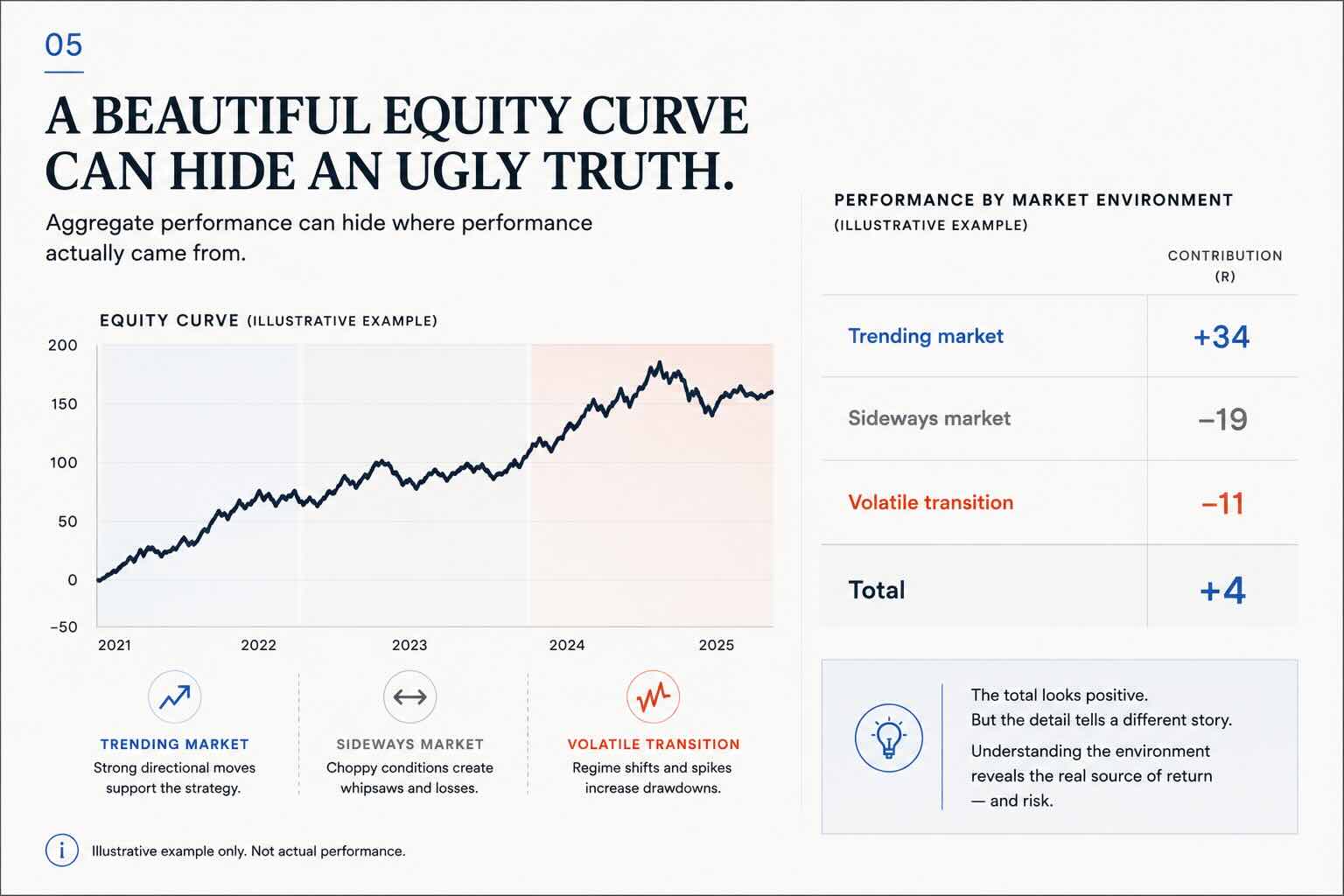
This is why analysing performance across different environments can be more informative than looking only at a single headline metric.
A 2026 study of an adaptive cryptocurrency trend-following framework, for example, explicitly included regime-conditional performance decomposition across bull, bear and sideways markets as part of its robustness testing.
That does not prove that one particular regime model is correct.
It demonstrates something more fundamental:
Market context can be treated as part of strategy evaluation rather than as background noise.
There Is Another Layer: Execution
Even identifying a useful signal is not enough.
A model can be statistically interesting and still produce disappointing trading results.
Execution sits between prediction and outcome.
Fees matter.
Slippage matters.
Turnover matters.
Position sizing matters.
The frequency with which a system reacts matters.
A 2026 study using roughly 70,000 hourly BTC/USDT observations found that several machine-learning models produced positive gross performance in selected configurations, yet naive trading rules failed after transaction costs were introduced.
A more selective, cost-aware execution rule substantially reduced turnover and improved results in selected configurations. The researchers also found that performance remained uneven across market regimes.
That distinction is crucial.
A forecast is not a trade.
A trade is not an outcome.
Between them sits an entire execution and risk architecture.
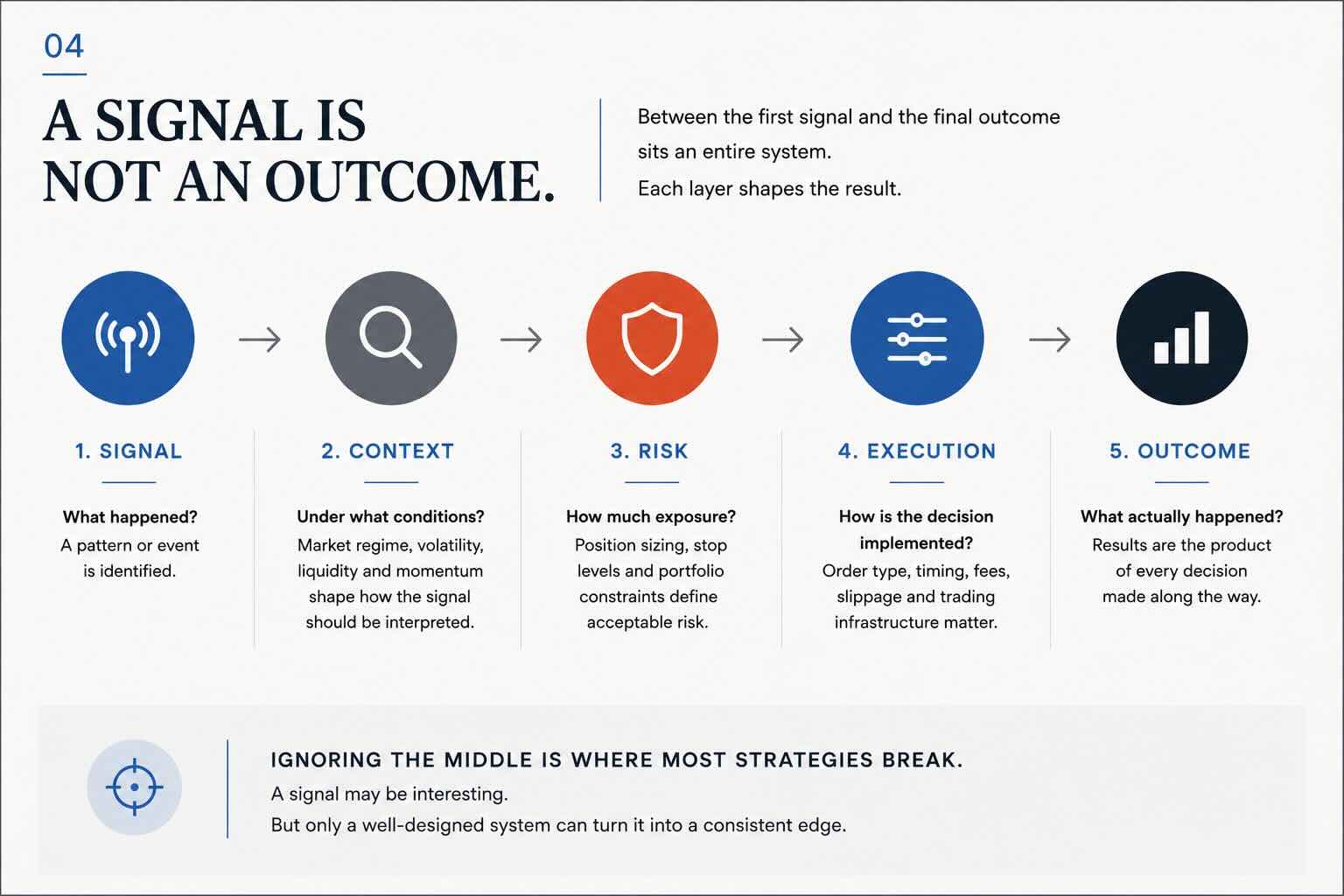
Systematic trading is often marketed as though the first box is everything.
Find the signal.
Find the indicator.
Find the algorithm.
Find the AI model.
But increasingly sophisticated prediction does not remove the other layers.
In some circumstances, it may make disciplined testing and controls even more important.
That principle can also be seen in regulated algorithmic trading. In February 2026, the European Securities and Markets Authority highlighted governance, pre-trade controls, testing frameworks and responsible use of AI among the areas relevant to supervision of algorithmic trading firms under MiFID II.
The regulatory context is different from retail cryptocurrency strategy tools, but the engineering principle is worth noticing:
Automation does not eliminate the need for control architecture.
Regime Awareness Is Not Market Prediction
There is an important distinction here.
Recognising market conditions does not mean knowing what the market will do next.
A volatility regime can change.
A trend can reverse.
A range can break.
A classification can be wrong.
Market regimes themselves are not perfectly observable states with labels conveniently attached to the price chart.
They are models.
And models contain uncertainty.
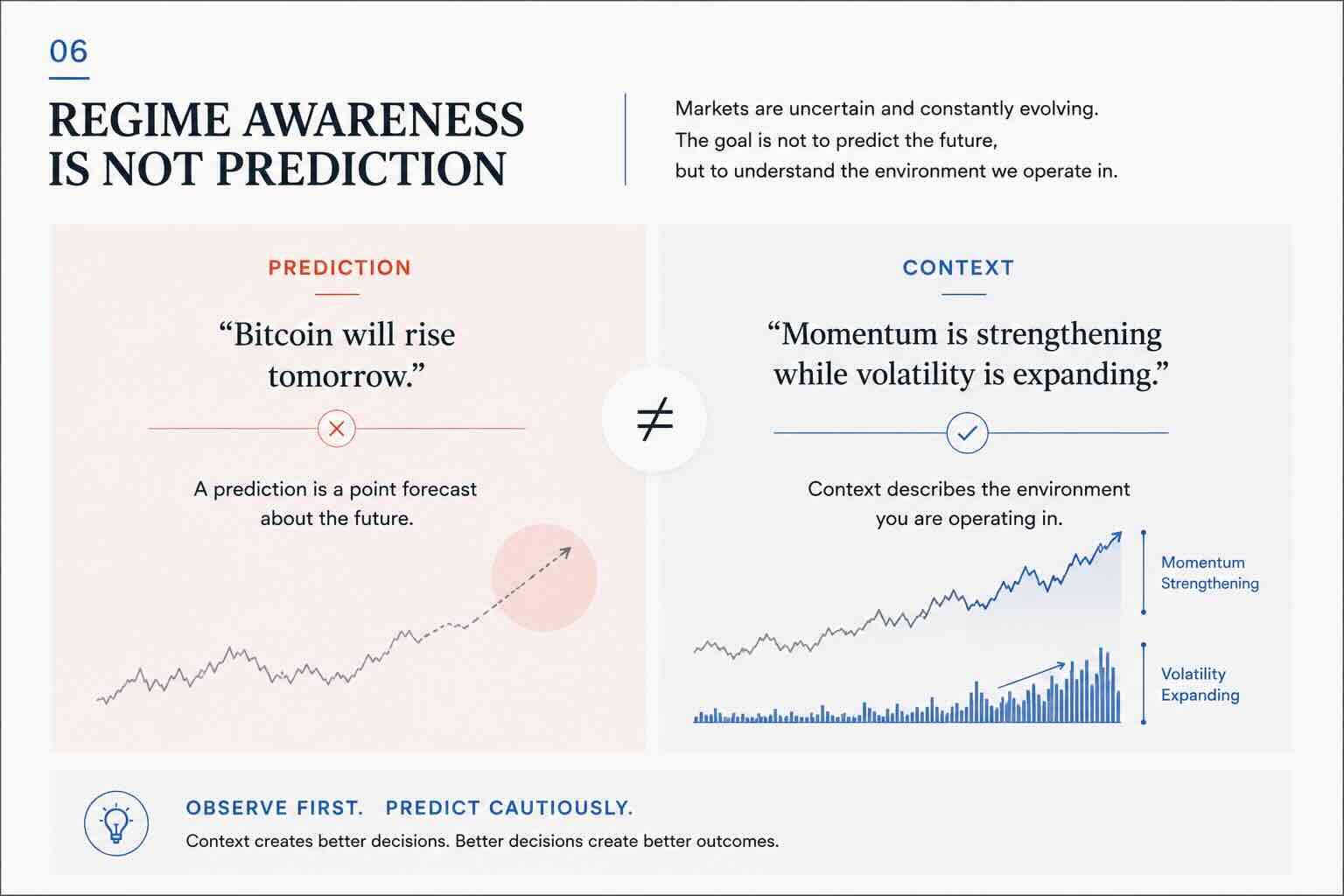
This is why regime awareness should not become another promise of prediction.
Its value is more modest — and arguably more useful.
It can provide context.
Instead of pretending to know the future, a system can describe the environment in which its decisions are being made.
That is a very different proposition.
From Automatic Trading to Structured Trading
Automation solves a real problem.
Computers can monitor rules continuously.
They do not become tired.
They do not miss a signal because they were making coffee.
They can execute defined instructions consistently.
But consistency is only valuable if the instructions deserve to be followed.
That suggests a different philosophy for trading technology.
Not:
Automate everything.
But:
Structure first. Automate second.
Define the strategy.
Understand the assumptions.
Observe the market environment.
Define the risk boundaries.
Test the behaviour.
Then automate execution.
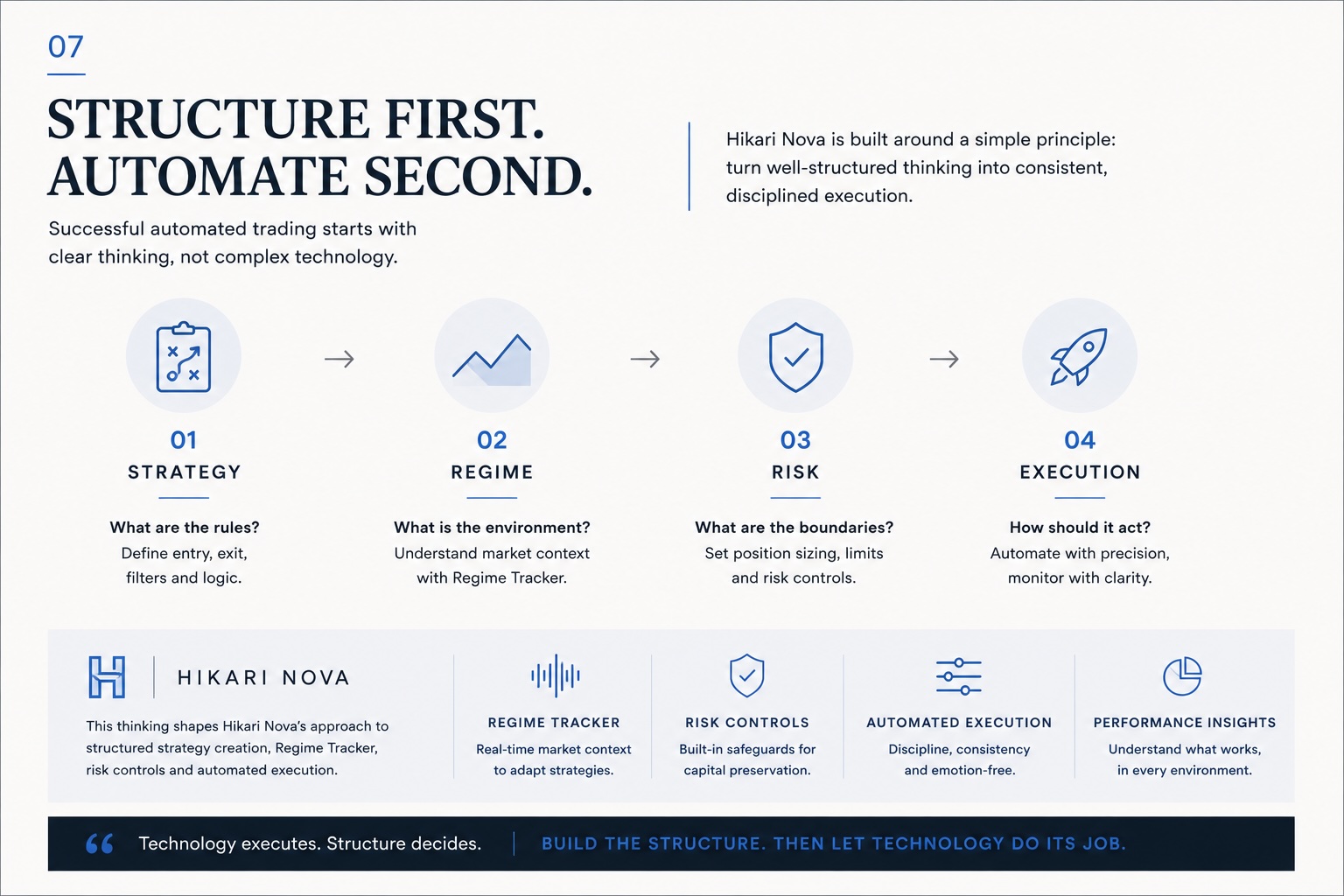
This thinking shapes Hikari Nova's approach to structured strategy creation, market-regime awareness, risk controls and automated execution.
The purpose is not to create a machine that claims to know what markets will do next.
It is to create a clearer relationship between strategy, market conditions, risk and execution.
The Perfect Strategy Probably Isn't the Right Objective
Markets evolve.
Participants change.
Liquidity changes.
Volatility changes.
Relationships that appeared persistent can weaken.
New relationships can emerge.
A strategy therefore should not earn trust simply because it once produced an attractive historical curve.
Trust has to be earned through evidence.
Across time.
Across conditions.
Across failures.
Across costs.
And across uncertainty.
The goal is not necessarily to find a strategy that never fails.
Such a strategy would be an extraordinary claim.
A more useful objective is to understand how, where and why a strategy behaves the way it does.
Because when performance changes, there are at least two very different possibilities.
The strategy may have stopped working.
Or the environment in which it was designed to work may have changed.
Understanding the difference is where systematic trading starts becoming genuinely interesting.
The Question to Ask
The next time a trading strategy begins behaving differently, perhaps the first question should not be:
“What's wrong with the strategy?”
Ask instead:
“What changed in the market?”

THE STRATEGY CHANGED.
OR
THE MARKET CHANGED.
KNOWING THE DIFFERENCE MATTERS.
That question may reveal considerably more.